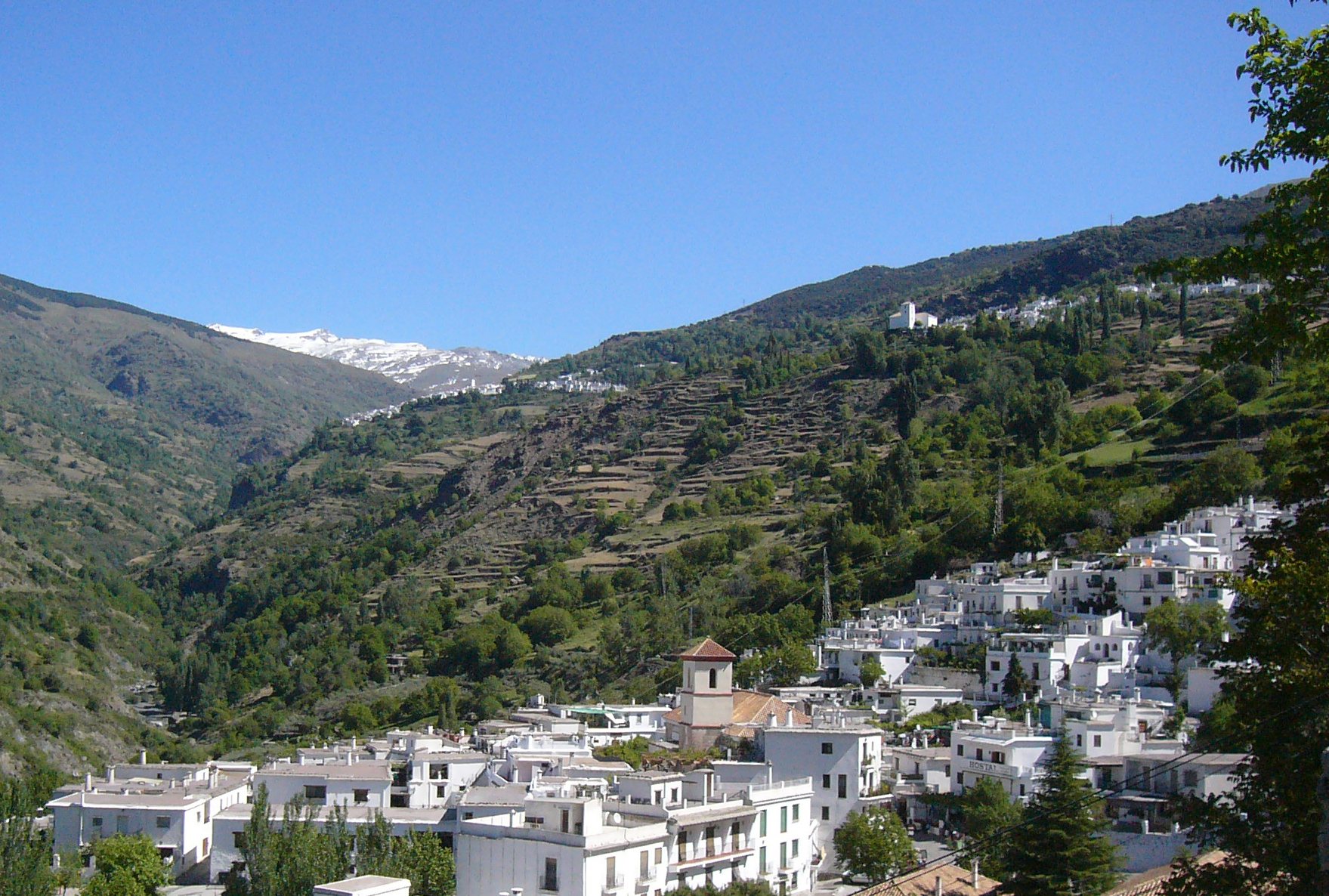
Málaga lies a good hour's drive west of Playa Tropical and can easily be done in a day. Walk up to the Moorish castle Alcazaba, see the cathedral, Picasso's birthplace and the market hall, walk down Calle Larios to the port – and finish with grilled sardines on the beach. Here is the route, prices and how to get there.
Alcazaba – the castle-palace above the city
In the middle of Málaga rises a hill with walls and towers. At the bottom lies Alcazaba, the Moorish castle-palace. According to the city council, the castle is first mentioned in the year 755, and it was rebuilt into a palace in the 11th century and again in the 14th century under the Nasrid kings of Granada. You walk up steep, cobbled ramps through several gates and end up in small courtyards with fountains, orange trees and water basins – a kind of little brother to Alhambra.
Right by the entrance on Calle Alcazabilla lies Teatro Romano, a Roman theatre from around the birth of Christ. It was only rediscovered in 1951 when a garden layout was being planned. The theatre and the small visitor centre are free and, according to the Junta de Andalucía, open Tuesday–Saturday 10–18 and Sundays and public holidays 10–16 (closed Monday).

Stairs and ramps: There are many sloping paths and steps. If you have difficulty walking, use the lift from Calle Guillén Sotelo behind the castle. According to the official page, it leads up to a hall by Patio de los Naranjos, sparing you the climb from Alcazabilla.
Castillo de Gibralfaro – the view
At the top of the mountain lies Gibralfaro, a 14th-century castle built under Yusuf I. It was a garrison right up to 1925, when the city council took it over. You can walk along the walls all the way around, and the view over the harbour, the bullring and the city is the best in Málaga. There is a small museum about the castle's history.
From Alcazaba to Gibralfaro there is no internal connection. You can walk up Paseo de Don Juan Temboury (approx. 20 minutes, steep and in the sun) or take city bus 35 (EMT), which according to the city council runs about every half hour from the centre. Good advice: take the bus up and walk down.
Opening hours and tickets as of October 2026
| Ticket | Alcazaba | Alcazaba + Gibralfaro |
|---|---|---|
| Standard | 7 € (≈ 52.22 kr.) | 10 € (≈ 74.60 kr.) |
| Concession (EU citizens over 65, pensioners, students, disabled) | 3 € (≈ 22.38 kr.) | 5 € (≈ 37.30 kr.) |
| Children under 6 years | free | free |
| Everyone, Sundays from 14:00 | free | free |
Open every day: winter (1 November – 31 March) 9–18, summer (1 April – 31 October) 9–20. Last entry one hour before closing. The official page mentions no weekly closing day. Tickets are bought at the ticket desk or on the official ticketing site. Allow 1–1½ hours in Alcazaba and an hour on Gibralfaro.
The Cathedral – "La Manquita"
Málaga Cathedral was built from 1528 to 1782, but was never completely finished. The southern tower is missing – which is why the locals call it La Manquita, "the one-armed". According to Spanish Wikipedia, the money was used by the crown in the late 18th century to support the Americans in the War of Independence against England; a plaque at the cathedral commemorates this. The northern tower is, according to the cathedral itself, 87 metres high (Wikipedia says 84 m) and the highest cathedral tower in Andalusia.

Price as of October 2026: €10 (≈ 74.60 kr.) with audio guide, over 65s €9 (≈ 67.14 kr.), youths aged 13–17 €6 (≈ 44.76 kr.), children under 13 free (without audio guide). With virtual reality experience €15 (≈ 112 kr.). Opening hours differ slightly in two places on the cathedral's own page; winter hours are approx. weekdays 10–18:30, Saturday until 18, Sunday 14–18, last entry 45 minutes before. During weekend masses there are no tourist visits. See the cathedral's page with prices and times.
The popular trip up to the cathedral roof (approx. 200 steps) is suspended due to roof work according to the cathedral's page, October 2026.
Picasso: the museum and the birthplace
Pablo Ruiz Picasso was born in Málaga on 25 October 1881. Two places in the old town are dedicated to him, and they are only a five-minute walk from each other.
Museo Picasso Málaga
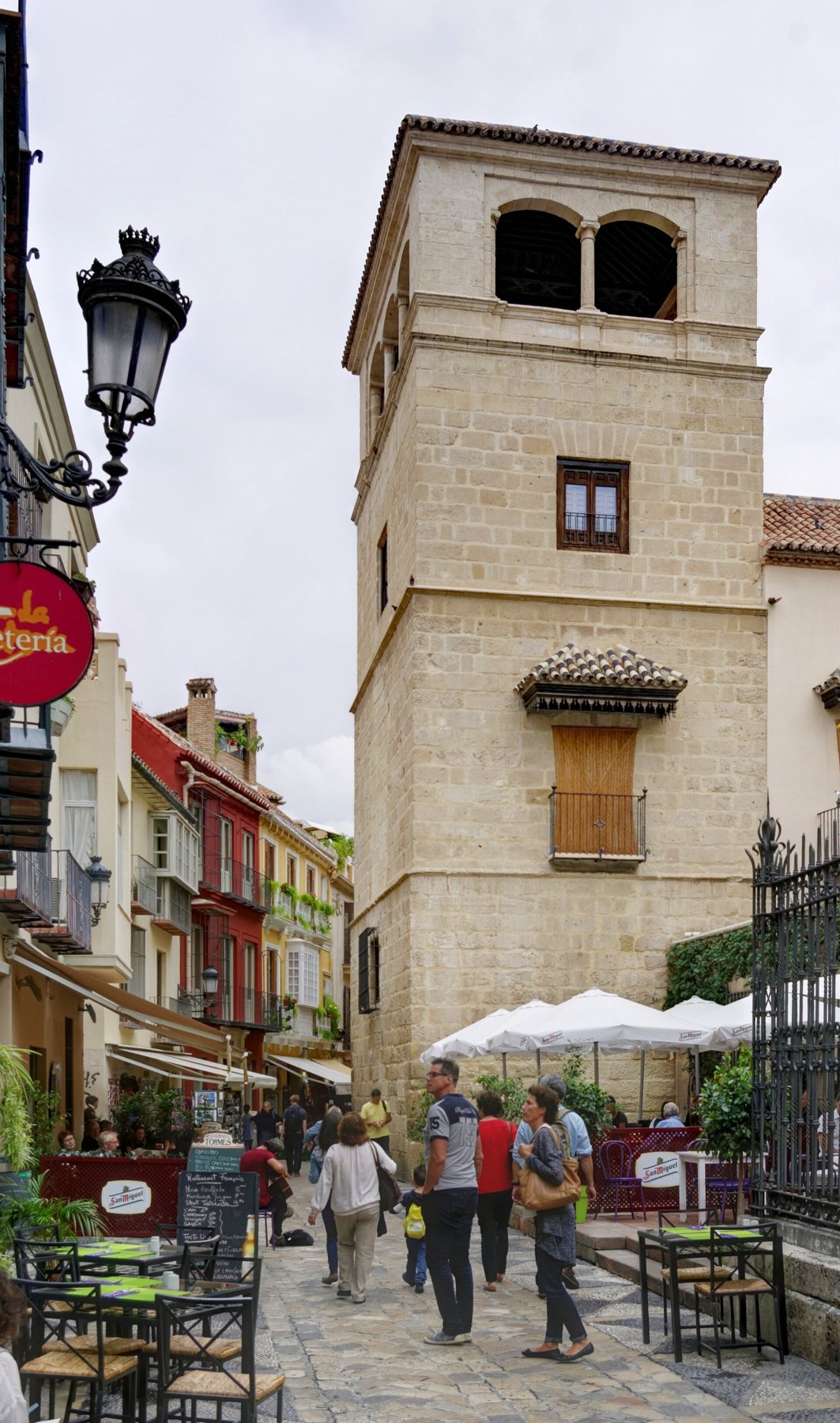
The museum opened on 27 October 2003 in Palacio de Buenavista, a Renaissance palace on Calle San Agustín 8, a few steps from the cathedral. Here hang paintings, drawings, sculptures and ceramics from his entire life. There is a cafe, garden and bookshop. Allow 1½ hours.
- Open all days: November–February 10–18, March–June and September–October 10–19, July–August 10–20. Entry up to 30 minutes before closing. Closed 25 December, 1 and 6 January.
- Price: €13 (≈ 96.98 kr.). Over 65s and students under 26: €11 (≈ 82.06 kr.). Under 17s free.
- Free for everyone every Sunday the last two hours before closing (the ticket office closes half an hour before).
Picasso's birthplace – Plaza de la Merced 15
Picasso was born in a yellow house on the corner of Plaza de la Merced, a large square with trees and an obelisk. His birth apartment is today the museum Museo Casa Natal with period furniture, the family's belongings and his father's paintings. It is small – a half-hour visit – and cheap.
- Open: all days 9:30–20 (last entry 15 minutes before). Closed 1 January and 25 December.
- Price: €3 (≈ 22.38 kr.), with the temporary exhibition €4 (≈ 29.84 kr.). Over 65s: €2 (≈ 14.92 kr.) / €2.50 (≈ 18.65 kr.). Under 18s free.
- Free for everyone Sundays 16–20 and on Picasso's birthday on 25 October.
- Free audio guide. The house is adapted for visitors with reduced mobility.
Mercado de Atarazanas – the market hall
Five minutes from Calle Larios lies the city's large market hall. The site was a shipyard for the Nasrid kings in the 14th century, and the old Moorish marble doorway from the shipyard is set into the middle of the facade today. The iron hall itself was designed by Joaquín de Rucoba; it was completed in 1879. According to the city council, the hall was renovated 2008–2010 and has 260 stalls. At the back of the hall, a large glass window with the city's coat of arms and ships fills the entire gable.


Inside the hall there are small bars where you can get fried fish, seafood and a glass of wine at the counter right among the stalls. Several guides state that the hall is open Monday–Saturday approx. 8–15 and is closed Sunday; the city council's own page does not state the times. Come before noon if you want to see the fish – on Mondays, according to the guides, there is only a little fish because the fishermen don't go out on Sundays.
Calle Larios, Muelle Uno and Centre Pompidou
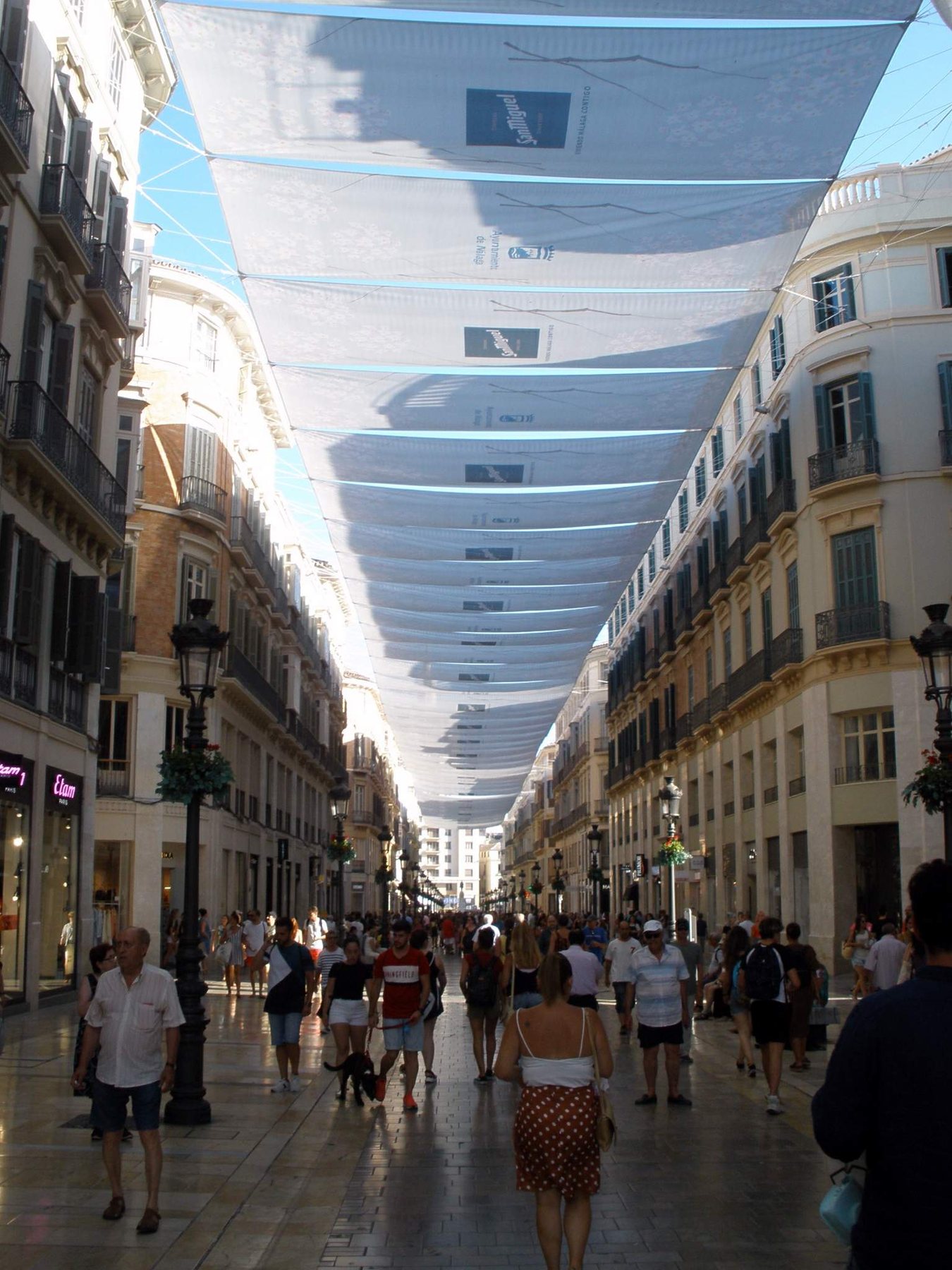
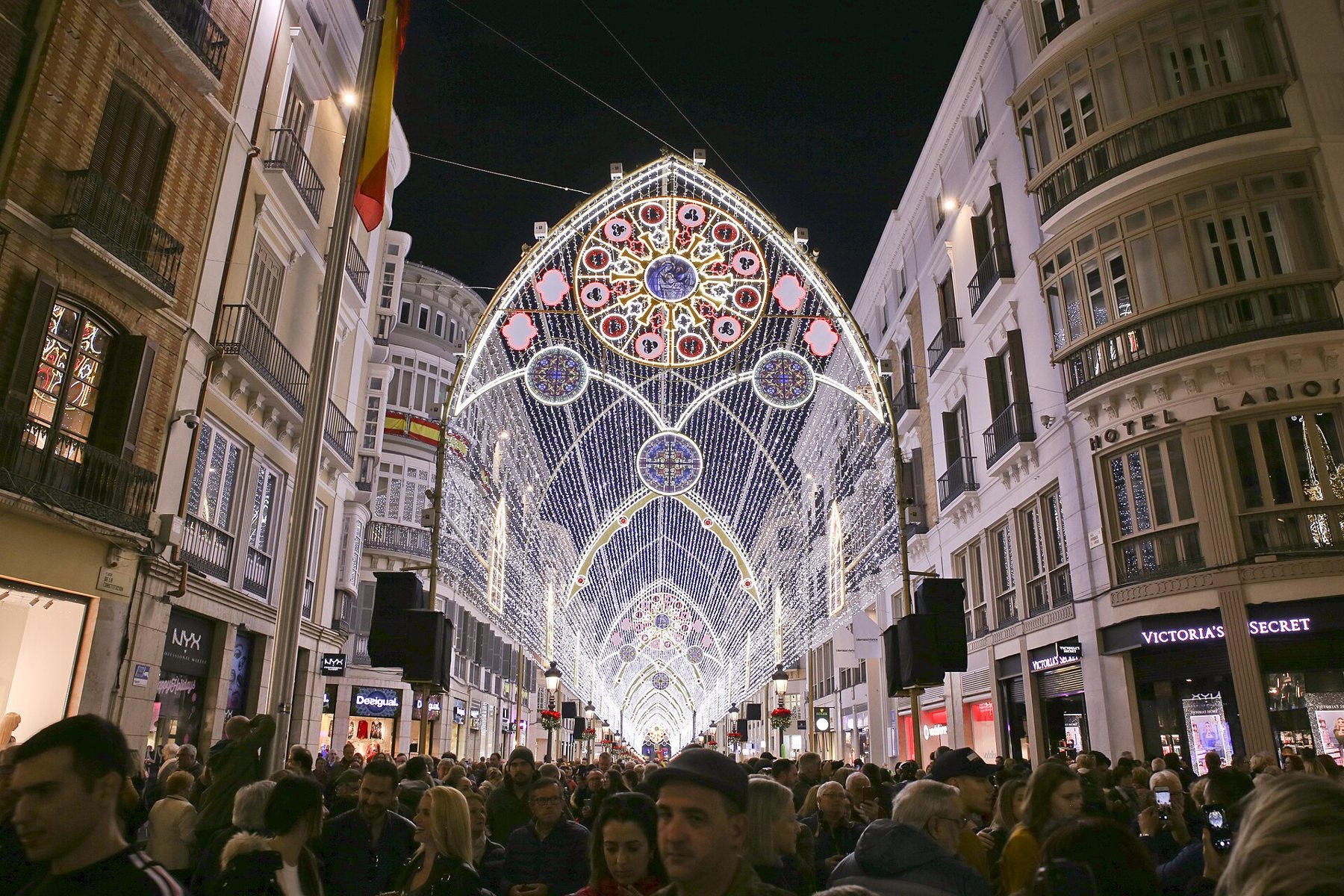
Calle Marqués de Larios was inaugurated on 27 August 1891 and is named after Manuel Domingo Larios, 2nd Marquess of Larios from the well-known Larios family, who also owned sugar factories on the coast. The street has been pedestrianised since 2002. In summer, sails are hung over the street to block the sun, and at Christmas it is famous for its grand light show (see "Festivals" below).
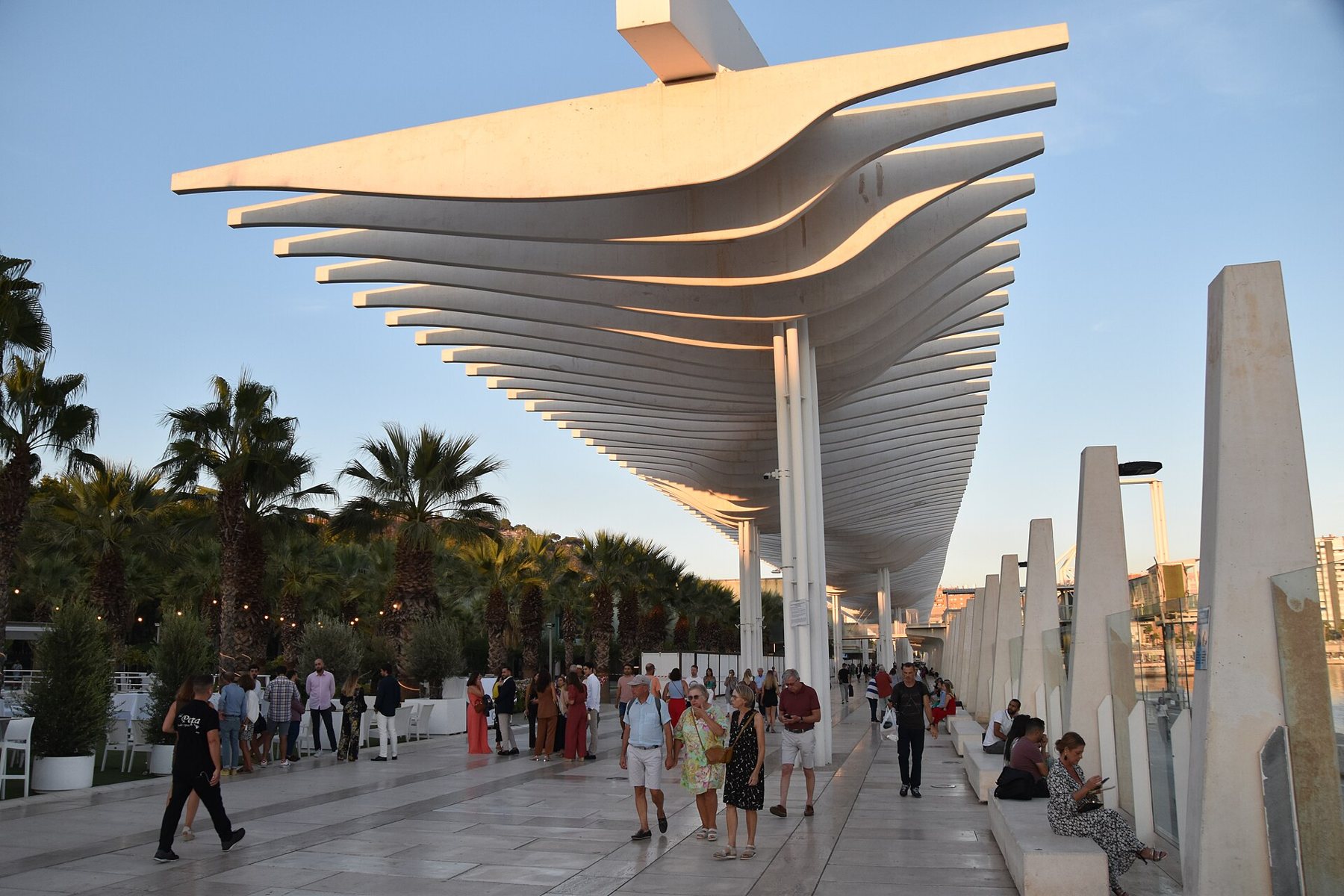
At the end of the street you walk through the park Paseo del Parque to the harbour. Muelle Uno opened on 29 November 2011 and is a long quay with shops, restaurants and the white pergola Palmeral de las Sorpresas, which provides shade all the way along the water. From here there is a great view back towards Alcazaba and Gibralfaro.

Centre Pompidou Málaga
At the very end of the quay stands a cube of coloured glass, El Cubo, decorated by the French artist Daniel Buren. Beneath it lies a branch of the French art museum Centre Pompidou, opened in 2015. The agreement with Paris has been extended, so the museum will remain in Málaga at least until 2035. Here you can see modern and contemporary art in changing exhibitions.
- Open: 9:30–20, closed Tuesday (open on public holidays that fall on a Tuesday). Closed 25 December and 1 January.
- Price: €9 (≈ 67.14 kr.) for both exhibitions, concession (over 65s) €5.50 (≈ 41.03 kr.). Permanent collection only: €7 (≈ 52.22 kr.) / €4 (≈ 29.84 kr.).
- Free for everyone Sundays from 16:00. Under 18s always free.
The beaches: Malagueta and Pedregalejo – and espetos
Just east of the harbour lies the city beach La Malagueta, a 10-minute walk from the centre. It has a Blue Flag, and the city council provides toilets, showers and lifeguards – during the bathing season 15 June – 15 September.
Four to five kilometres further east lies Pedregalejo, an old fishing district with low houses right on the beach and a long row of chiringuitos – beach restaurants. This is where you should eat espetos: sardines put on a reed skewer and grilled over an olive wood fire, often in an old boat filled with sand. According to Wikipedia, they only take about six minutes. You eat them with your fingers.


Drive to Pedregalejo in the afternoon. The beach promenade Paseo Marítimo Pablo Ruiz Picasso connects Malagueta and Pedregalejo, so it can also be walked (approx. one hour).
Food
- Espetos – sardines on skewers, see above. The season is best in summer, but the chiringuitos grill all year round.
- Pescaíto frito – small deep-fried fish: boquerones (anchovies), squid, redfish. Málaga's classic in bars and by the beach.
- Ajoblanco – cold soup of almonds, garlic, bread and olive oil, with grapes. A summer dish from the Málaga region.
- Málaga wine – sweet wines of moscatel and pedro ximénez. Try them in Antigua Casa de Guardia on Alameda Principal 18, a bodega from 1840 where the wine is poured straight from the barrels and the bill is still written in chalk on the counter.
- Coffee the Málaga way – the city has its own names depending on how much milk is in it: solo, largo, semilargo, solo corto, mitad (half and half), entrecorto, corto, sombra and nube (mostly milk). The system originates from Café Central on Plaza de la Constitución, which closed in January 2022 – but the names are still used all over the city.
Where: The market bars in Atarazanas for lunch, the small streets around the cathedral and Plaza de la Merced for tapas, and the chiringuitos in Pedregalejo for fish. We haven't checked prices. More about the region's dishes: food traditions and 3×10 things you must taste, eat and visit.
Toilets
- Museums: If you have a ticket for the Picasso Museum, Pompidou or the cathedral, use the toilet there. The museums' pages don't mention it directly – ask at the ticket desk.
- Gibralfaro: According to official history, the castle got toilets during the restoration 1989–1999. We haven't been able to confirm where they are today.
- Public toilet cabins: The city council began installing free, self-cleaning toilet cabins in the centre in 2022; the first one appeared on Plaza de la Marina, at the end of Calle Larios. We don't know if they all still work.
- The beaches: Malagueta and Pedregalejo have toilets and showers during the bathing season (15/6–15/9). Outside the season: use the chiringuitos.
- Cafes: Otherwise buy a coffee – then the toilet is sorted. Remember to use the toilet before walking up to Alcazaba.
Festivals and traditions
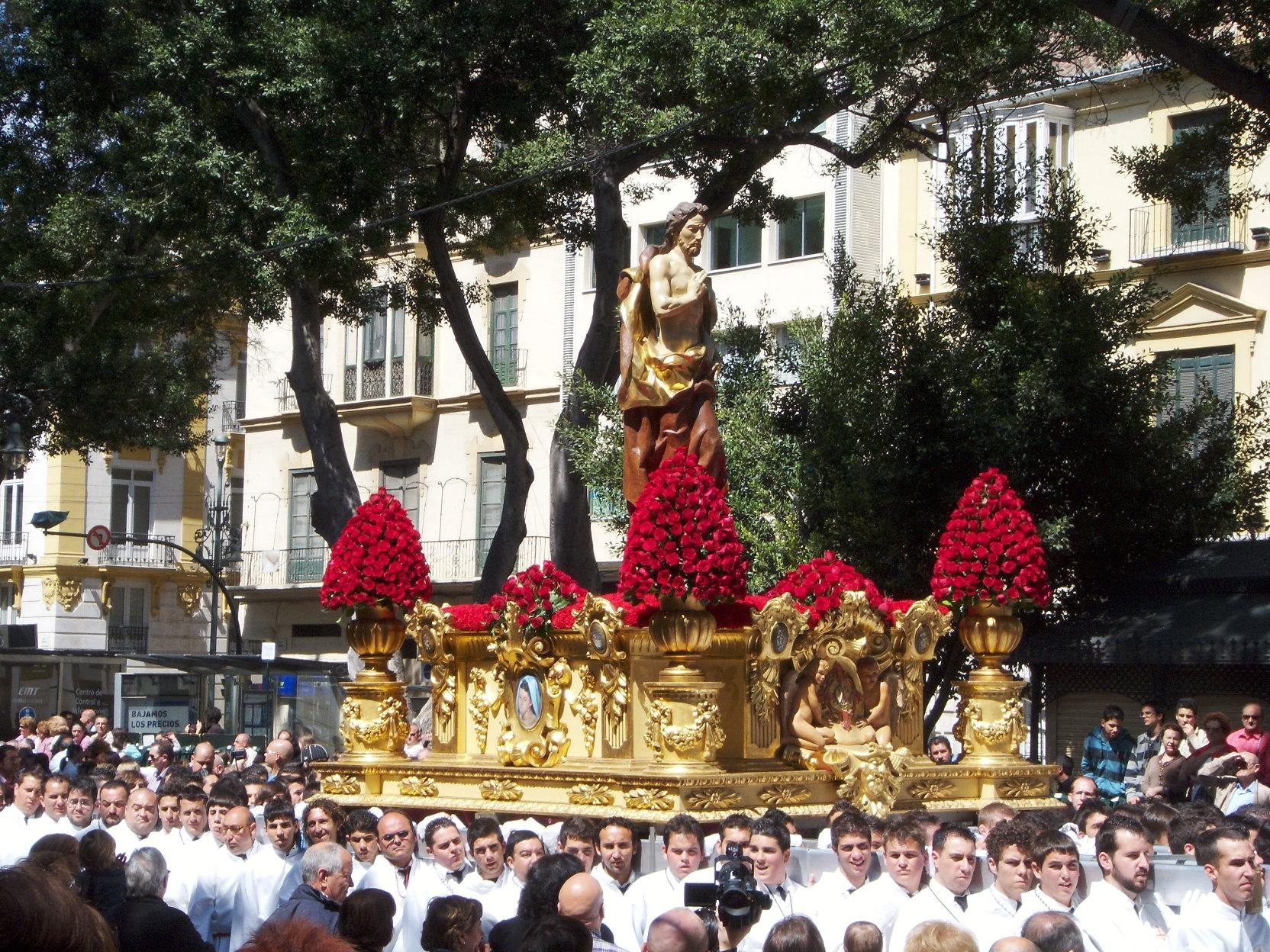
- Semana Santa (Holy Week): Málaga's Easter is one of Spain's biggest. The brotherhoods carry huge tronos – some require over 250 bearers – through the city from Palm Sunday to Easter Sunday, with the official route along Calle Larios. On Maundy Thursday the Spanish Legion, La Legión, follows Cristo de Mena. In 2026 it was 29 March – 5 April; in 2027 Easter Sunday is 28 March. The city is full and it's difficult to drive and park.
- Feria de Málaga, August: The city festival commemorates the Catholic Monarchs riding into the city on 19 August 1487. By day there is celebrating in the streets of the centre (Feria de día), by night at the fairground Cortijo de Torres. In 2026 it was 15–22 August.
- The Christmas lights on Calle Larios: Switched on in late November. There is a light show with music every evening at 18:30, 20:30 and 22:00, except 24 and 31 December. A great goal for a December trip.
- Picasso's birthday, 25 October: Free entry to the birthplace; the Picasso Museum celebrates its opening with free entry on 27 October.

Discover more local festivities along the coast on our festivals page.
How to get there
By car
Drive out onto the A-7 towards Málaga. There are approx. 76 km to the centre, and the trip takes about 1 hour and 10 minutes without traffic. The motorway is free along the entire stretch. Follow the signs "Centro" and "Puerto".
Parking: Do not drive into the narrow streets of the old town. The municipal company SMASSA runs underground car parks right next to the sights, including Alcazaba (beneath the Alcazaba and Teatro Romano, max height 2.10 m), Plaza de la Marina (by Calle Larios), Camas, Cervantes and Tejón y Rodríguez, and there is also a multi-storey car park at Muelle Uno. SMASSA's website shows available spaces, but we have not been able to find official hourly rates for 2026. See also parking and speed cameras.
Low Emission Zone (ZBE): Málaga has a low emission zone of around 400 hectares, monitored by cameras that read number plates. Vehicles without a Spanish emissions sticker that are not registered in Málaga are not allowed to enter, and from 30-11-2026, according to the municipality, this will also apply to vehicles with a B sticker. Cars with a C, ECO or 0 sticker are permitted – newer Spanish rental cars typically have these. How the rules apply to foreign vehicles is unclear, and the matter is before the courts. If you are driving your own older car, check the municipality's ZBE page before travelling – or take the bus.
The buttons below the map at the bottom open the route from Playa Tropical directly in Google Maps – both the direct route via the A-7 and the route with stops along the way.
By bus
ALSA runs from the bus station in Almuñécar (Avenida del Rey Juan Carlos I) to Málaga bus station (Estación de Autobuses, Paseo de los Tilos). According to ticketing sites, the journey takes around 1 hour 15 minutes, there are 14–18 departures a day, and tickets cost from around 9 € (≈ 67.14 kr.) (summer 2026 figures). From the bus station, it is about 1.3 km – an easy 15-minute walk – to Atarazanas and Calle Larios. Timetables vary by season, so check ALSA before you travel. See also buses.
The benefit of taking the bus: no parking hassles, no low emission zone, and you can enjoy a glass of wine with lunch.
Sights along the way
The A-7 runs high above the coast. If you want to make the journey part of the day's experience, you could take some of these detours:
- Nerja (26 km, approx. 30 mins): the town famous for the Balcón de Europa viewpoint and the caves just beforehand. A coffee on the Balcón de Europa makes a lovely first break. Read more in our article about the Nerja Caves and Balcón de Europa.
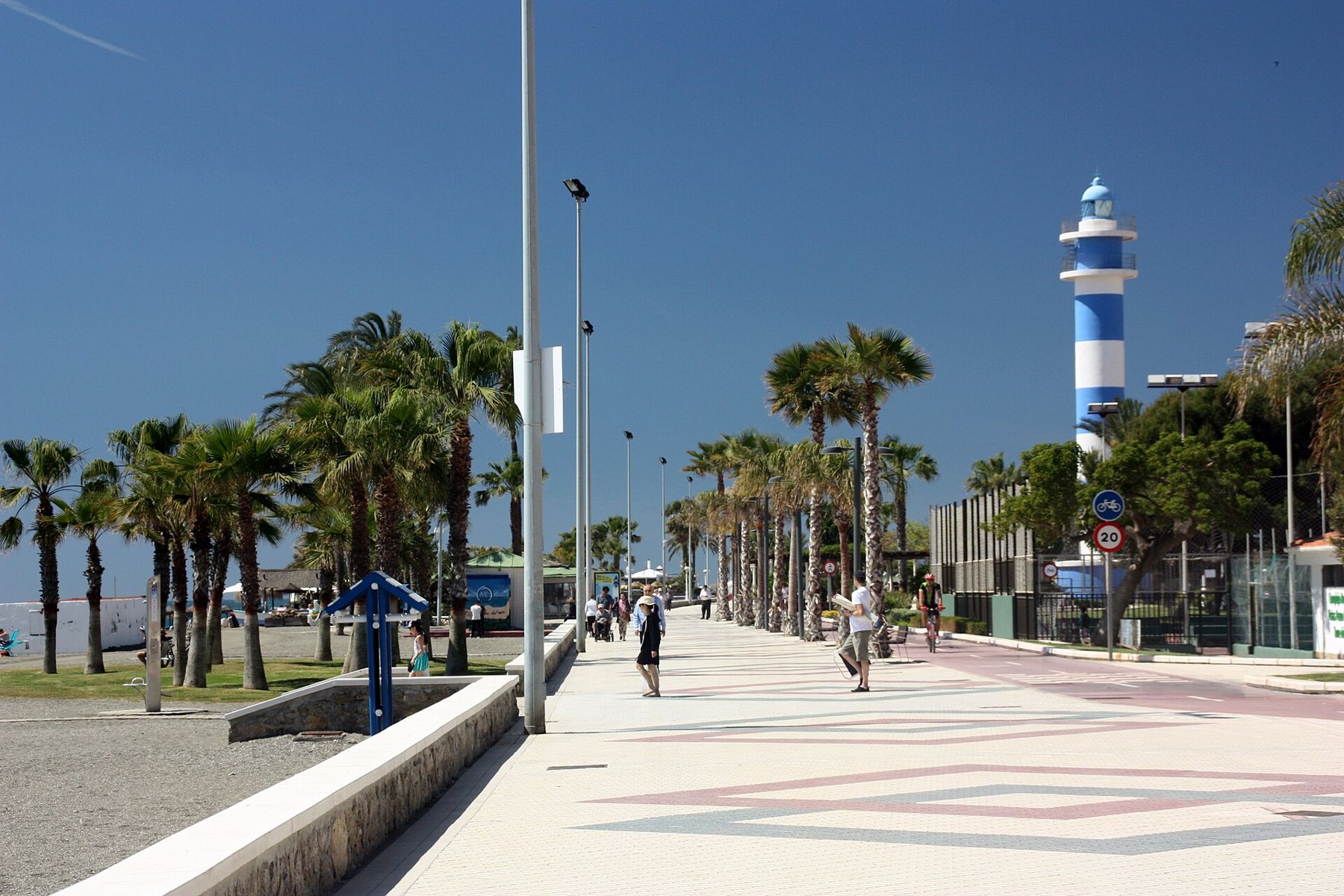
- Torre del Mar (48 km, approx. 45 mins): Vélez-Málaga's seaside resort with around 24,000 residents, a long beachfront promenade and a blue-and-white lighthouse. There are actually three lighthouses in the town. A great place to stretch your legs.
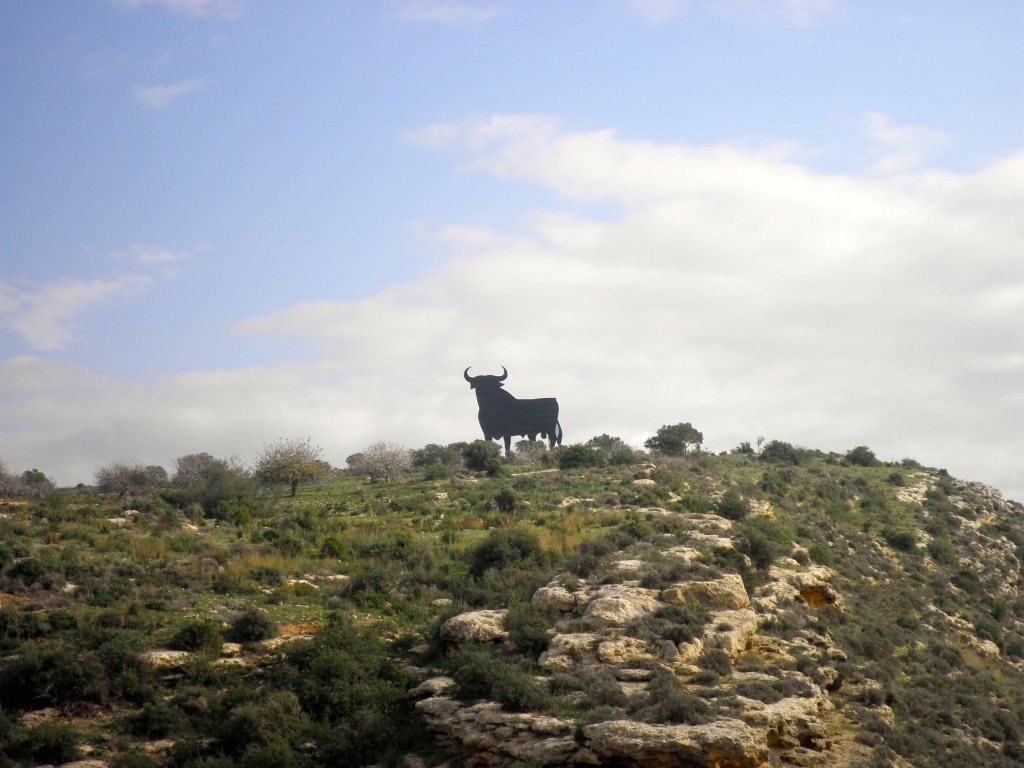
- The Osborne bull at Almayate (51 km): On the rocky outcrop Peñón del Toro right by the coast between Torre del Mar and Almayate stands one of the few remaining large black Osborne bulls in Spain. You can spot it from the road. Read the story of the bulls in the Osborne bull. Ancient Phoenician excavations (Los Toscanos) are also located near Almayate.
Suggested day trip
| Time | Facility |
|---|---|
| 08:30 | Depart from Playa Tropical along the A-7 (or take the ALSA bus from Almuñécar) |
| 09:45 | Park in Parking Alcazaba. Explore the Teatro Romano (free admission, closed Mondays) |
| 10:00 | Alcazaba (1–1½ hours). Take bus 35 up to Gibralfaro and walk back down – or skip Gibralfaro |
| 12:30 | Plaza de la Merced and Picasso's birthplace, followed by the Picasso Museum or the cathedral |
| 14:00 | Lunch at the market bars in Atarazanas (open until around 15:00, closed Sundays) |
| 15:30 | Calle Larios, Paseo del Parque, Muelle Uno and perhaps Centre Pompidou (closed Tuesdays) |
| 18:00 | Drive over to Pedregalejo: a stroll along the beach and espetos for dinner |
| Evening | Return via the A-7, approx. 1 hour |
It makes for a full day. You may prefer to pick two or three sights and enjoy them at a leisurely pace – Málaga easily rewards multiple visits.
Maps and routes
Red star = Playa Tropical. Click on a point for the name and distance. Map data © OpenStreetMap.
Open the route in Google Maps
- Drive from Playa Tropical to Málaga (Parking Alcazaba)Approx. 76 km, approx. 1 hr 10 mins via the A-7 towards Málaga. The car park is right beneath the Alcazaba.
- Along the coast with stops on the wayNerja, the lighthouse in Torre del Mar and the Osborne bull at Almayate – ending at the car park by the Alcazaba.
- Round trip: city centre, espetos in Pedregalejo and back homePark at the Alcazaba, drive out to Pedregalejo in the afternoon for dinner, and return via the A-7.
- Walking tour of the old town and portFrom the car park: Alcazaba, Picasso's birthplace, Picasso Museum, the cathedral, Atarazanas, Calle Larios, Muelle Uno, Pompidou and Malagueta – approx. 4 km.
- By ALSA bus: from the bus station to the centreThe bus from Almuñécar terminates at Málaga bus station. From here, it is around 1.3 km to Calle Larios.
The routes start at Playa Tropical. On mobile devices, they open directly in the Google Maps app, ready for navigation.
Good advice
- Check the day of the week. The Teatro Romano is closed on Mondays, Centre Pompidou on Tuesdays, and the market hall on Sundays.
- Take advantage of Sunday afternoons. The Alcazaba and Gibralfaro are free from 14:00, Picasso's birthplace from 16:00–20:00, Pompidou from 16:00, and the Picasso Museum during its last two hours.
- Wear sturdy shoes. The Alcazaba has steep, slippery cobblestones, and the path up to Gibralfaro is a 20-minute climb.
- Use the lift. From Calle Guillén Sotelo, you can reach the top of the Alcazaba without taking the steep path.
- Bring your passport or ID. Discounts for over-65s require proof of age.
- Avoid driving during Easter Week and the feria. The city centre is closed to traffic and packed – take the bus instead.
- Check the low emission zone, especially if you are driving your own older vehicle.
- Arrive early. During summer it gets hot in the middle of the day – visit the fortresses in the morning and head to the beach in the evening.
Prices and opening times are from official websites in October 2026 and may change. The cathedral rooftop tour is suspended until further notice.
Sources
- Alcazaba y Gibralfaro: Horarios y tarifas, History of the Alcazaba, History of Gibralfaro, Dónde estamos (bus 35) and Visiting the Alcazaba (lift)
- Junta de Andalucía: Teatro Romano de Málaga
- Málaga Cathedral: prices and times, rooftop tour and architecture
- Museo Picasso Málaga: Visita
- Museo Casa Natal Picasso: Horarios y tarifas
- Centre Pompidou Málaga: Visita and Nosotros; Málaga municipality on the extension to 2035
- Málaga municipality: Mercado de Atarazanas and Andalucía.org: Mercado Central de las Atarazanas
- Málaga municipality: La Malagueta and Pedregalejo–Las Acacias
- Málaga municipality: Zona de Bajas Emisiones and notice regarding B stickers from 30-11-2026; The Local 26-01-2026 on foreign vehicles
- SMASSA: municipal car parks and Parking Alcazaba
- Málaga municipality 2022: free public toilets, first at Plaza de la Marina
- ALSA: Almuñécar and Omio: Almuñécar–Málaga (travel time, departures, fares)
- Wikipedia (es): The Cathedral, Calle Marqués de Larios, Muelle Uno, Teatro Romano, Espeto, Pedregalejo
- Wikipedia (es): Feria de Málaga, Semana Santa en Málaga; Málaga municipality on the 2026 feria
- Wikipedia (es): Torre del Mar and Almayate
- Andalucía.org: Antigua Casa de Guardia
- Directo al Paladar: Café Central and coffee terminology
- Driving distances: OSRM/OpenStreetMap
- Coordinates: OpenStreetMap contributors (ODbL)
Krone amounts are converted at 1 € ≈ 7.46 kr. and rounded.