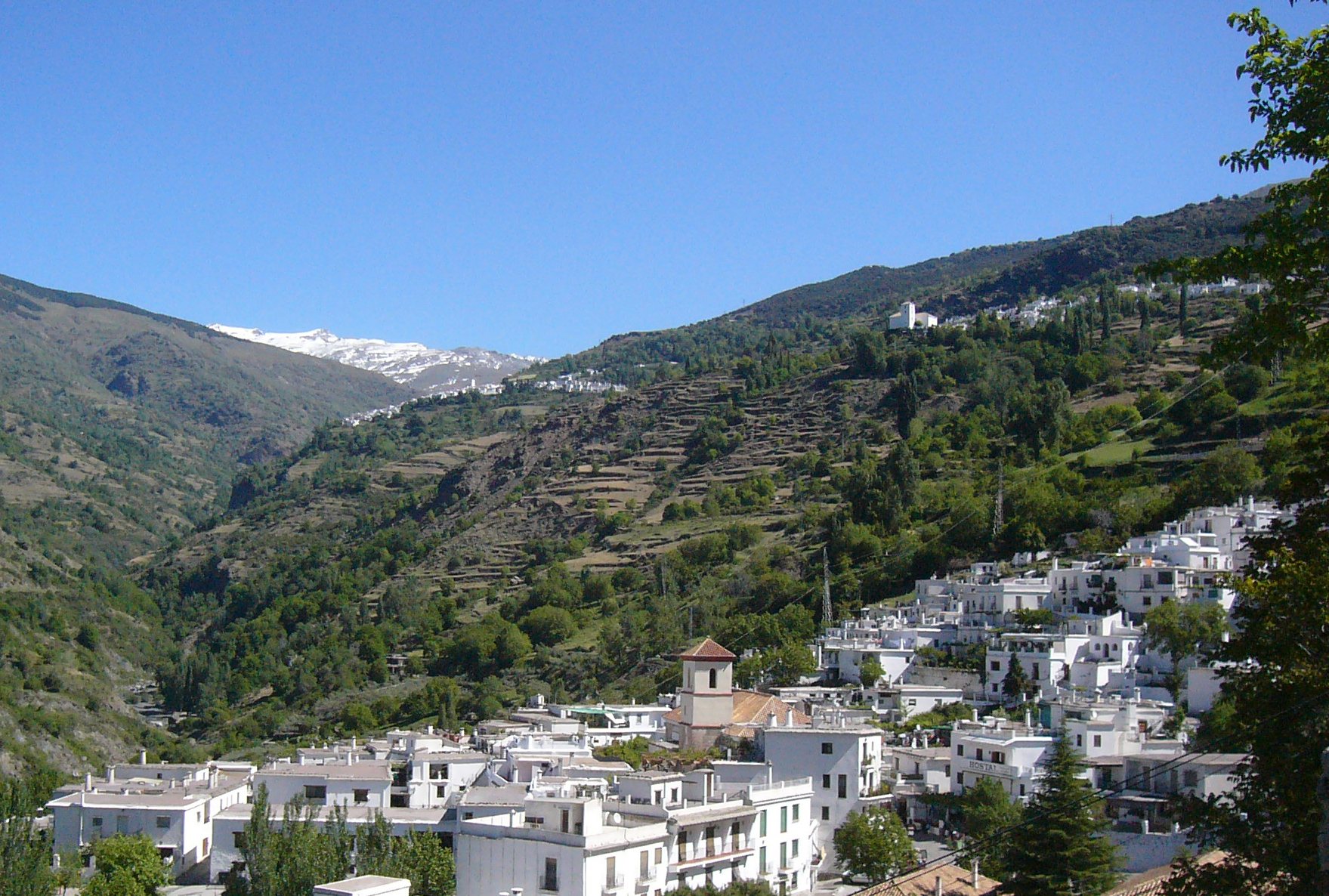
Just over an hour from the beach lies the Alpujarras: white mountain villages with flat roofs, capped chimneys and narrow streets where mountain water trickles through stone channels. Here is your guide for a day exploring the spa town of Lanjarón, the Thursday market in Órgiva, the three villages of the Poqueira gorge and the cured-ham capital of Trevélez – including driving routes, times, dining tips, toilets and local fiestas.
Alpujarras – the land beyond the mountains
The Alpujarras (in Spanish La Alpujarra) is the collection of valleys and gorges tucked along the southern flanks of the Sierra Nevada, between the high peaks and the sea. The region is shared between the provinces of Granada and Almería. Rivers fed by the snows of Mulhacén and Veleta rush down through steep ravines into the Río Guadalfeo, which meets the sea near Motril – the very river you cross on the motorway heading east.
Following the fall of Granada in 1492, the Alpujarras became the final stronghold for Muslims forced to convert to Christianity – the Moriscos. In 1568 they rose in revolt. After the conflict, they were expelled, and the villages were resettled with farming families from northern Spain, many from Galicia. Even so, the distinctive architecture, irrigation channels, terraced fields and local place names still trace their roots back to Moorish times.
This itinerary takes you through the most visited villages in the western region: the spa town of Lanjarón, the market town of Órgiva, the three gems of the Poqueira gorge – Pampaneira, Bubión and Capileira – and Trevélez, perched high beneath the peaks of Mulhacén.
How to get there
By car
Take the A-7 towards Motril, then join the A-44 towards Granada. From there, two scenic routes lead up into the Alpujarras:
- The Vélez de Benaudalla route (the shortest): Leave the A-44 at Vélez de Benaudalla and follow the A-346 up alongside the Río Guadalfeo and the Rules reservoir to Órgiva. Approx. 43 km from Playa Tropical to Órgiva, taking around 45 minutes.
- The Lanjarón route: Continue north along the A-44 across the gorge at Tablate and branch off onto the A-348 towards Lanjarón and Órgiva. It is about 14 km further to Pampaneira, but it takes you straight through Lanjarón.
From Órgiva, take the A-4132 (Carretera de Órgiva a Trevélez) winding up the mountain to Pampaneira (14 km). Just after Pampaneira, a turn-off leads up to Bubión and Capileira. The A-4132 continues eastward through Pitres, Pórtugos and Busquístar all the way to Trevélez.
| From Playa Tropical to | Distance | Approx. driving time |
|---|---|---|
| Órgiva | 43 km | 45 mins |
| Lanjarón (the spa) | 46 km | 45 mins |
| Pampaneira | 57 km | 1 hr 10 mins |
| Capileira | 63 km | 1 hr 20 mins |
| Trevélez | 80 km | 1½ hours |
| Yegen (Gerald Brenan's village) | 88 km | 1 hr 40 mins |
Times are estimated via OpenStreetMap without stops. The roads are narrow and full of sharp bends, shared with local buses, lorries and cyclists. Journeys often take longer than navigation apps suggest. The stretch from Capileira to Trevélez spans 23 km and takes roughly 40 minutes.
Parking: Avoid driving directly into the village centres – the lanes are simply too narrow. In Pampaneira, free parking areas are situated at the village entrance, and in Capileira you will find spaces both at the entrance and to the north of the village. On weekends and public holidays these fill up rapidly, so aim to arrive early. See also our guides on car hire and speed cameras.
The buttons beneath the map at the bottom of the page open the routes from Playa Tropical directly in Google Maps – whether you want the direct route to Pampaneira, the two scenic options with stops along the way, or a full circuit to Trevélez and back.
By bus
There are no direct buses running from Almuñécar into the mountain villages. ALSA operates services from Motril to Órgiva, and from Granada via Lanjarón and Órgiva up to Pampaneira, Bubión, Capileira and Trevélez, but there are only a handful of departures each day. For instance, Capileira town council lists departures from Capileira to Granada at 07:15, 16:50 and 18:35 (timetable as of May 2025). Piecing together a day trip from the coast by bus is rather difficult. Always verify current times at alsa.com, and find out more about local transport on our bus page.
Sights along the way
- Vélez de Benaudalla – a whitewashed hillside town along the A-44 with the peaks of Sierra Nevada looming behind. It features the lovely Jardín Nazarí, laid out in traditional Moorish style. Nearby, the Guadalfeo carves through a dramatic gorge flanked by towering vertical rock faces.
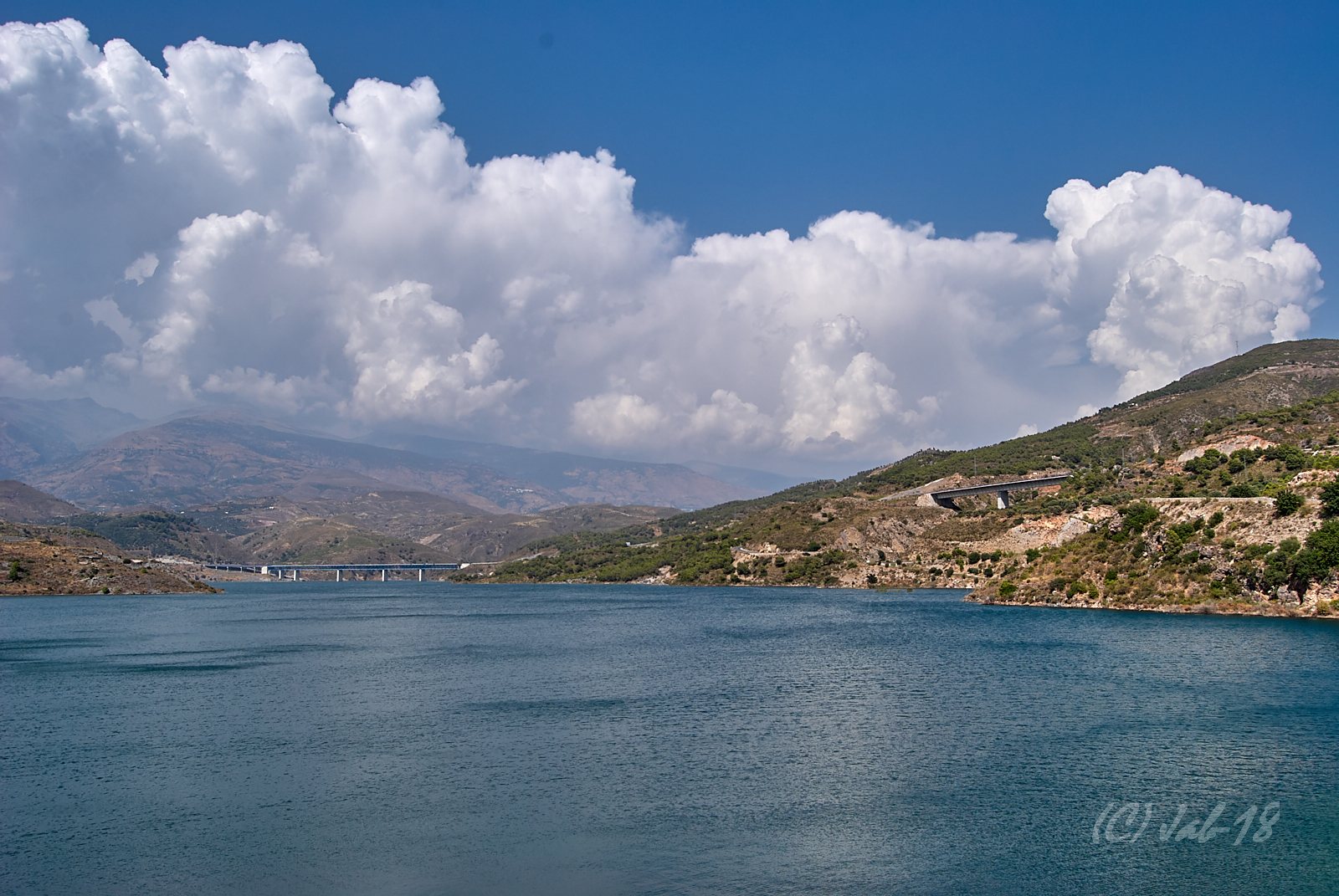
- Rules Dam – the dam across the Guadalfeo was inaugurated in 2004, collecting runoff from the Sierra Nevada, Sierra de Lújar and the Contraviesa. Stop at the Mirador de la Presa de Rules for sweeping vistas across the turquoise reservoir. It makes a convenient, short detour off the A-346.
- The Tablate Gorge (along the Lanjarón route) – here, three bridges from completely different eras span the ravine: the ancient stone bridge on the Royal Road from Granada to the Alpujarras (destroyed and rebuilt multiple times between the 1490s and 1796), a 19th-century bridge and the modern motorway viaducts. Tablate has historically served as the true "gateway" to the Alpujarras.
- Lanjarón – the first town in the Alpujarras when arriving via the A-348. See below.
- The view from the A-4132 – climbing up from Órgiva, you can gaze right down across the Guadalfeo valley and the Rules reservoir. Pull in at the Mirador de Poqueira petrol station, situated just below Pampaneira, for a breath of fresh air and photos.
Guide: a day in the Alpujarras
You cannot easily see everything thoroughly in a single day. Here is a tried-and-tested plan:
- Morning: Head up along the A-346. If it is a Thursday, drop into the lively weekly market in Órgiva.
- Mid-morning: Pampaneira – stroll through the cobbled alleys, browse the vibrant jarapa rugs, and relax with a coffee on the main square (approx. 1 hour).
- Lunchtime: Bubión and Capileira – enjoy a hearty lunch overlooking the deep gorge (2 hours).
- Afternoon: Drive on to Trevélez to sample the world-famous cured ham (a 40-minute drive, 1 hour in the village). Alternatively, head home via Lanjarón and unwind with a dip in the thermal spa baths.
- Heading back: From Trevélez, it takes roughly 1½ hours to return to Playa Tropical. It is best to complete the mountain descent in daylight.
Lanjarón – pure spring waters and the thermal spa
Lanjarón (3,708 residents) is the western gateway to the Alpujarras, renowned throughout Spain for its bottled mineral water. The name most likely translates as "the place of springs". Fed by melting snows high in the Sierra Nevada, crisp, crystal-clear water bubbles up across town through public drinking fountains, many decorated with poetry or verses by Federico García Lorca.
The medicinal properties of the local waters first gained recognition towards the end of the 18th century, with construction of the thermal baths commencing in the late 19th century. Today's Balneario de Lanjarón on Avenida de Madrid is a graceful Neo-Mudéjar building from the early 20th century, complete with twin towers. The spa draws from six distinct mineral springs – one designated for bathing and five for drinking therapies.
| Balneario de Lanjarón | As of October 2026 |
|---|---|
| Aquatherma (thermal pools, jacuzzi, steam room and dry sauna), adult | 33,50 € (≈ 250 kr.) |
| Aquatherma, children aged 6–12 | 21 € (≈ 157 kr.) |
| Termas al Lanchar, private suite for two (60 mins) | 64 € (≈ 477 kr.) for two |
| Open | 10:00–14:00 and 16:30–20:30 |
You must book your session with reception in advance (tel. 958 770 137 or 958 770 452). Swimming caps are mandatory and may be purchased at reception. If you cancel less than 24 hours in advance, the full fee applies. The spa's official pages state both 50 and 60 minutes for an Aquatherma session. See the spa website.

Órgiva – the Thursday market
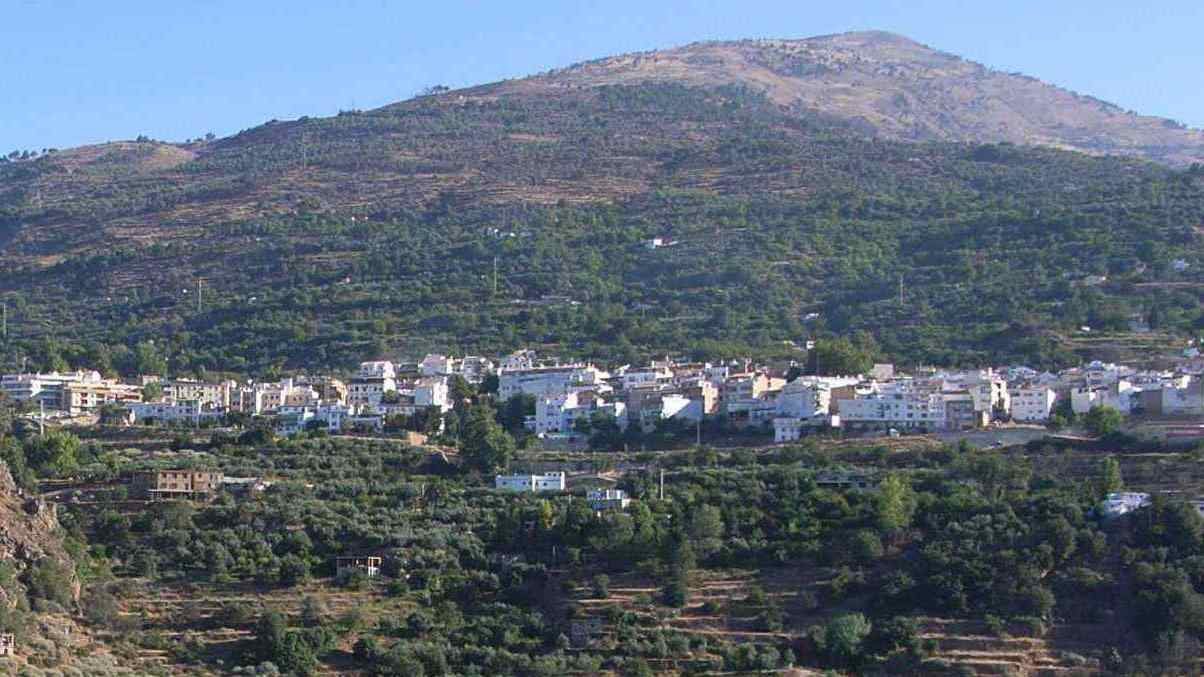
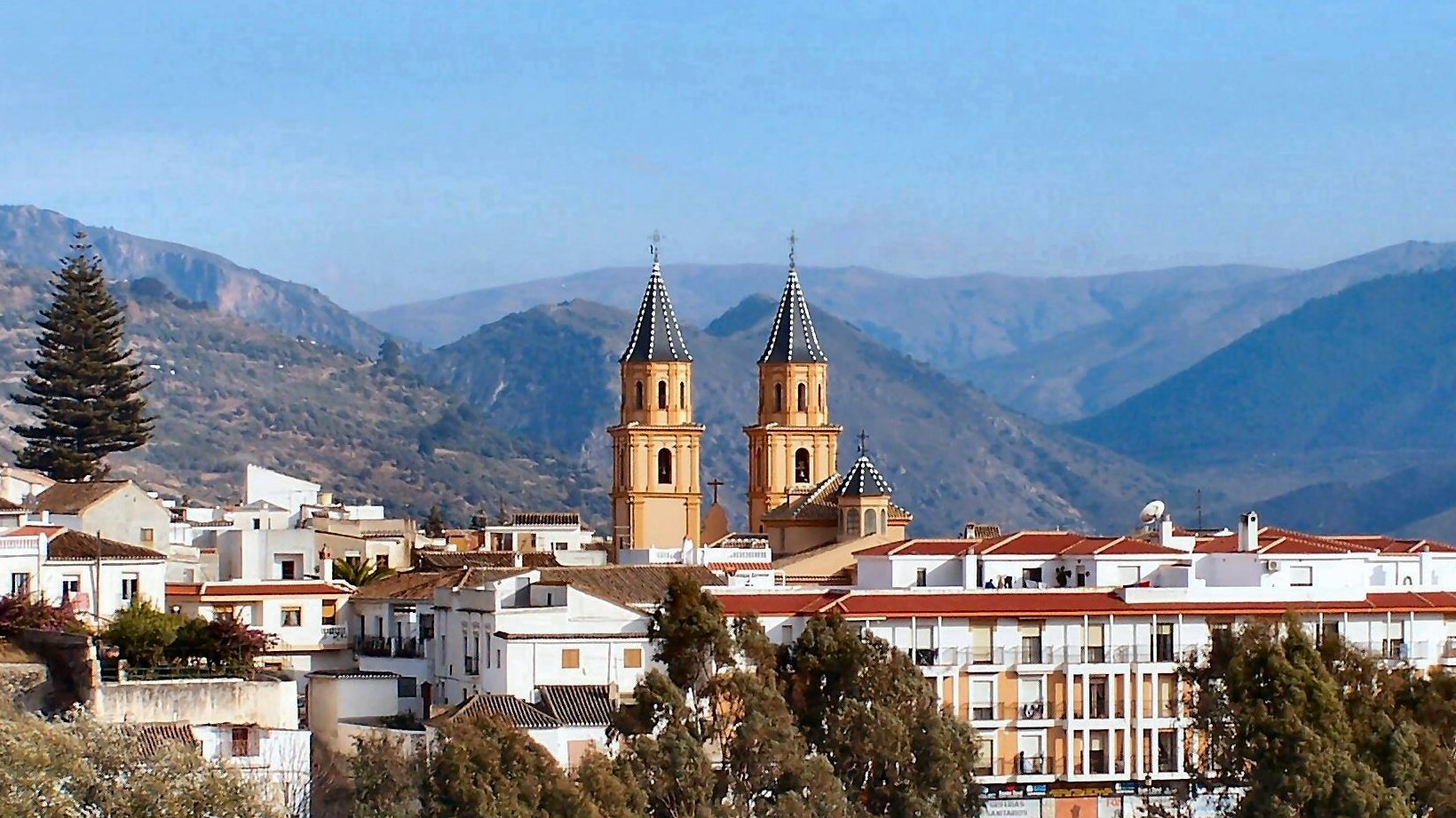
Órgiva (5,728 residents) sits on the floor of the Guadalfeo valley, roughly 450 m above sea level, and serves as the commercial hub of the Alpujarras. It is instantly recognisable by the twin spires of the church of Nuestra Señora de la Expectación. The town is also famous for its vibrant international and bohemian community who live here year-round.
Every Thursday, Órgiva plays host to its bustling market – combining a traditional street market (mercadillo ambulante) filled with fresh local fruit, vegetables and clothes, with an artisanal crafts fair. The town council confirms the weekly schedule. According to the market directory mercadillos.org, stalls are set up on Plaza de la Alpujarra from 09:00 to 14:00. During local celebrations (such as late September), the market relocates temporarily. Find out more about surrounding markets on our market page.
A pleasant surprise for Danish visitors: the Hurtado de Mendoza Library holds a remarkable collection of Don Quixote translated into over 50 languages – including a Danish edition from 1869.

Pampaneira – lowest of the three villages
Pampaneira (312 residents, approx. 1,060 m) is the first village you come across in the Poqueira gorge. The heart of the village is Plaza de la Libertad, bordered by the church, bustling café terraces and craft shops displaying colourful jarapa rugs. Wander up through the steep alleys, where mountain meltwater runs down stone rills along the centre of the cobbles, and duck under the covered passageways (tinaos), where traditional whitewashed houses bridge the narrow streets overhead.
Pampaneira, Bubión and Capileira were officially declared Historic-Artistic Sites in November 1982. All three belong to the prestigious association Los Pueblos Más Bonitos de España – with Pampaneira being the very first village in Granada province to be admitted, back in 2013.

Bubión – the middle village
Bubión (305 residents, approx. 1,350 m) sits midway up the Poqueira valley, enjoying sweeping vistas that can take in both the Mediterranean Sea and the snow-capped Sierra Nevada on a clear day. Down in the oldest part of the village you will find the parish church, town hall and Casa Alpujarreña, a charming museum set in an ancestral home displaying folk furniture, tools and crafts. Be sure to seek out the historic public washhouses (lavaderos). Museum opening hours could not be verified.
Capileira – crowning the gorge
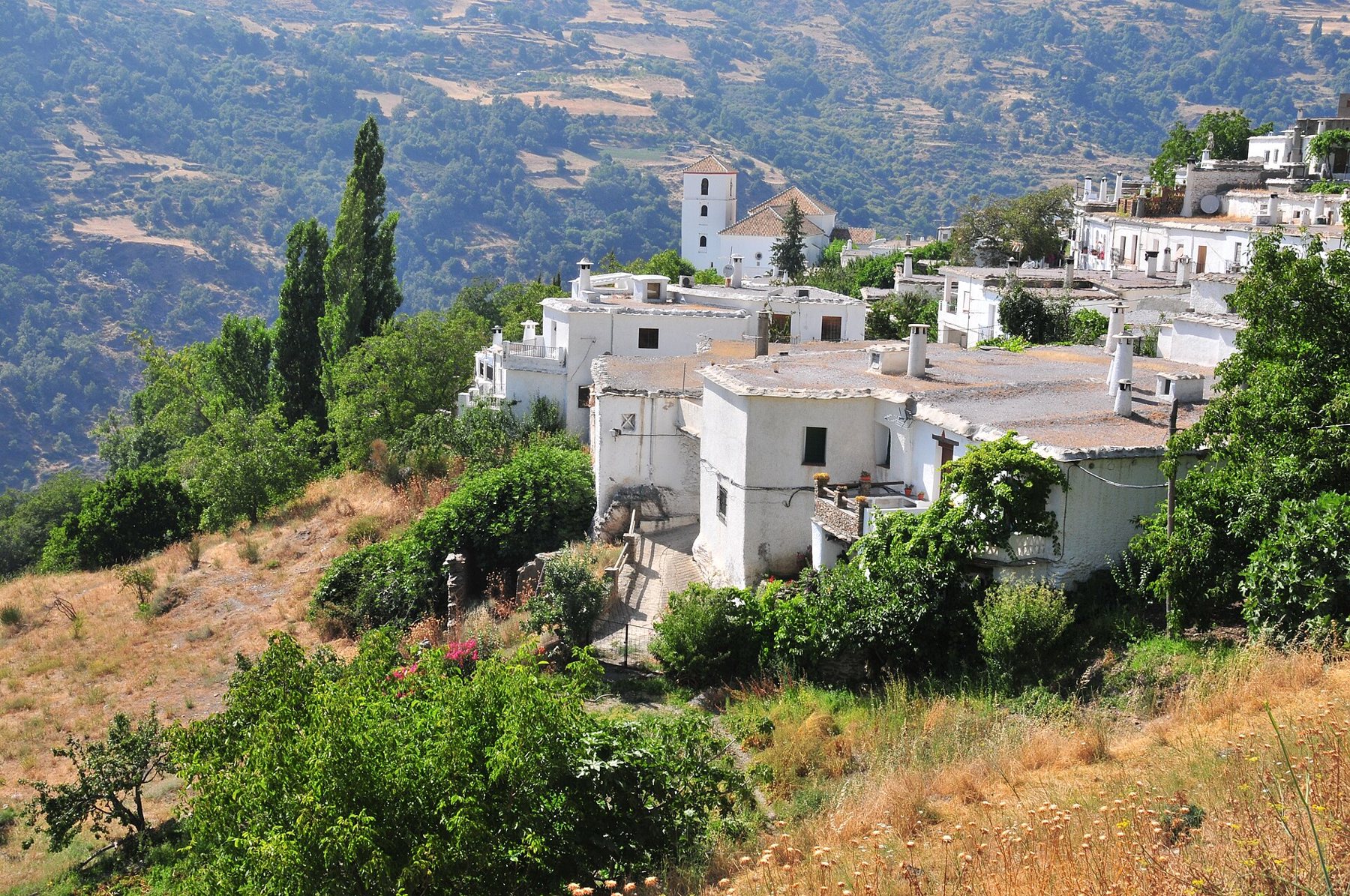
Capileira (590 residents) is the highest of the three gorge villages – the local council describes it as sitting at "nearly 1,500 metres above sea level". The municipal boundary stretches all the way up to the summit of Mulhacén (3,479 m), the highest peak on the Iberian Peninsula. The village looks out over dizzying drops down the valley and up towards the snowfields.
- The Parish Church of Nuestra Señora de la Cabeza boasts a gilded 17th-century Baroque altarpiece and a statue of the Virgin Mary, reputedly gifted by the Catholic Monarchs. Open Wednesday–Sunday 10:00–14:00 and 16:00–19:00 (until 21:00 in summer).
- The Casa-Museo Pedro Antonio de Alarcón on Calle Mentidero celebrates the traditional folk culture of the Alpujarras as well as the 19th-century writer who penned the famous travelogue La Alpujarra (1874). OpenStreetMap lists opening times as Saturday 11:00–14:00 and 17:00–19:00, and Sunday 11:00–14:00 – it is best to ring the town hall (958 763 051) to confirm before travelling specifically for it.
- Walking between the villages: The marked circular hiking trail PR-A 70 "Pueblos del Poqueira" connects all three villages across the gorge. The town council advises avoiding the peak midday heat in summer, and notes that trails may see snow in winter.
- During the summer, an official guided minibus runs from Capileira up into the national park as far as Alto del Chorrillo (2,700 m). Advance booking is essential (tel. 671 56 44 06).

Trevélez – mountain air and cured ham
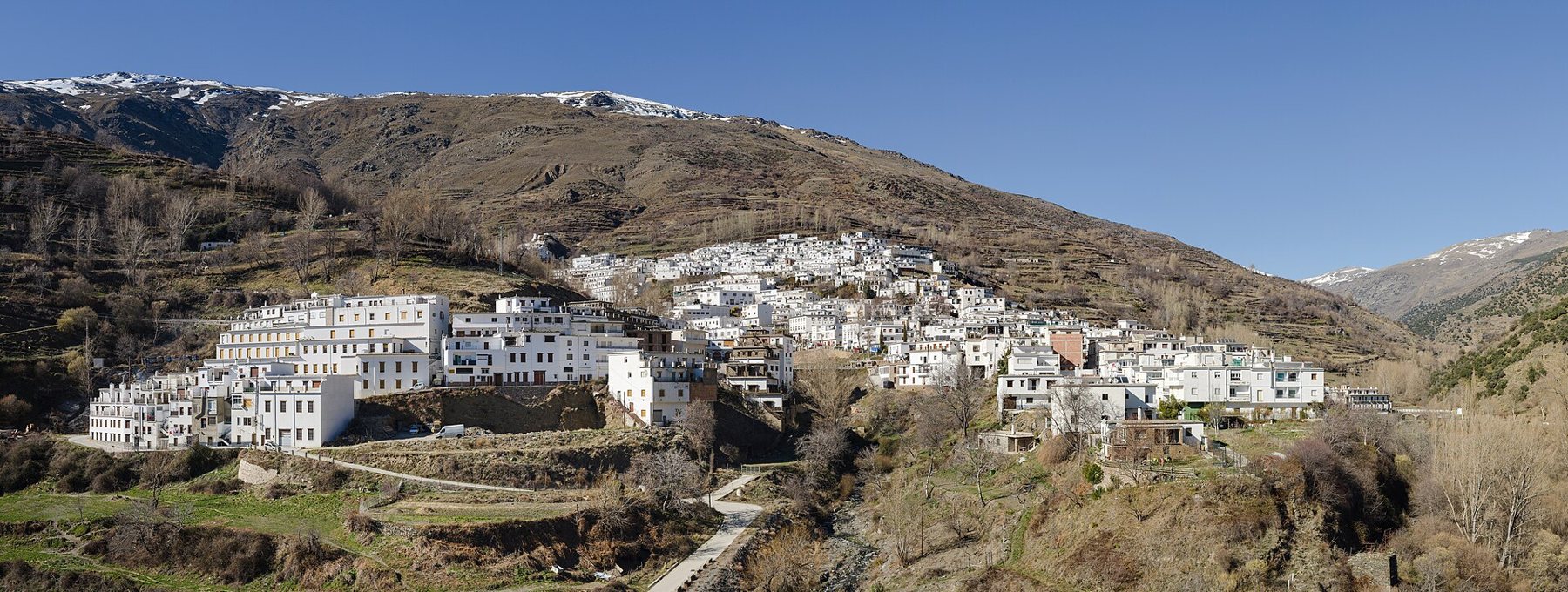
Trevélez (698 residents) is nestled along the river of the same name directly beneath Mulhacén, claiming the title of the highest municipality on the Iberian Peninsula. Its roadside sign proudly reads "the highest pueblo in Spain". The village lies around 1,480 m above sea level and is tiered into three distinct neighbourhoods – Barrio Bajo, Barrio Medio and Barrio Alto – with a vertical rise of 190 metres between them. The topmost home in Barrio Alto sits at an impressive 1,610 m above sea level.
Most day-trippers gather in Barrio Bajo near the bridge, where the traditional jamón bodegas and cured-ham shops are clustered. Venture up into Barrio Medio and Barrio Alto to discover pristine examples of historic Alpujarra stone architecture. Local lore tells that the village took its name from three brothers who divided their father's land, each settling in one of the three quarters – in the evening, three lone candles (velas) would flicker in their homes.
Flat roofs and capped chimneys
What lends the villages of the Alpujarras their unmistakable character is their rooftops. Rather than using terracotta tiles, the traditional cottages are capped with flat roofs – terraos – covered with launa, a distinctive bluish-grey clay derived from decomposed slate. When wet, launa forms an impermeable seal that keeps the rain out. There are practical reasons for these flat terraces: winter snow settles gently across the roof instead of avalanching down in front of the doorways, and local clay was poorly suited for baking tiles, leaving imported tiles an expense only the wealthiest could afford.
Perched atop these terraces are distinctive cylindrical whitewashed chimneys, each topped with a slate stone "cap". The houses are stepped up the natural gradient of the mountainside, meaning one family's roof often serves as their neighbour's sun terrace. Bridging the lanes are covered wooden-beamed walkways, tinaos, while irrigation water is guided throughout the hills via acequias, stone-lined canals engineered in Moorish times. The overall look bears an uncanny resemblance to Berber settlements in the Atlas Mountains of Morocco.

Jarapas – traditional rag rugs
Throughout Pampaneira, you will see vibrantly striped rugs draped over whitewashed walls. These are jarapas. The name stems from harapos, meaning "rags" or "scraps" – originally they were woven from offcuts of worn clothing and fabric remnants on rustic domestic looms. Historically they were practical essentials, used as floor runners, bedspreads, draft excluders and mattress protectors. Nowadays you will also find machine-woven varieties and synthetic yarns, so do ask if you are seeking a genuine handwoven piece.
In Bubión you can visit the Telar de Jarapas Hilacar workshop (Calle Carretera 29), founded by artisan weaver Ana Martínez over 30 years ago. According to the Junta de Andalucía, she weaves using antique wooden looms over 200 years old; visitors can watch the craft in action and even try their hand at the shuttle. Contact: tel. 658 10 65 76.


Gerald Brenan and "South from Granada"
The British author Gerald Brenan (1894–1987) arrived in Spain after the First World War and moved on 13-01-1920 into the village of Yegen, further to the east in the Alpujarras. Here he was visited by his friends from the Bloomsbury Group in London – the painter Dora Carrington, Lytton Strachey and, in 1923, Virginia and Leonard Woolf.
In 1957 he published the book South from Granada (in Spanish Al sur de Granada) about life in Yegen in the 1920s: the village customs, superstitions, fiestas and poverty. The book brought international renown to the Alpujarras, and in 2003 it was made into a film by Fernando Colomo starring Matthew Goode as Brenan. Brenan spent his final years in Alhaurín el Grande near Málaga.
Yegen lies approx. 30 km by road east of Trevélez – about 50 minutes along winding roads. In the village there is a commemorative plaque on Brenan's house, a marked walking trail (Sendero Local Gerald Brenan) and Espacio Brenan, a small museum with photographs of the village and its people. The photos were taken from the 1950s to the 1990s by the Dane J. Vagn Hansen, who was known locally as "Juan el Dinamarca". We have not been able to find the museum's opening hours.

Food
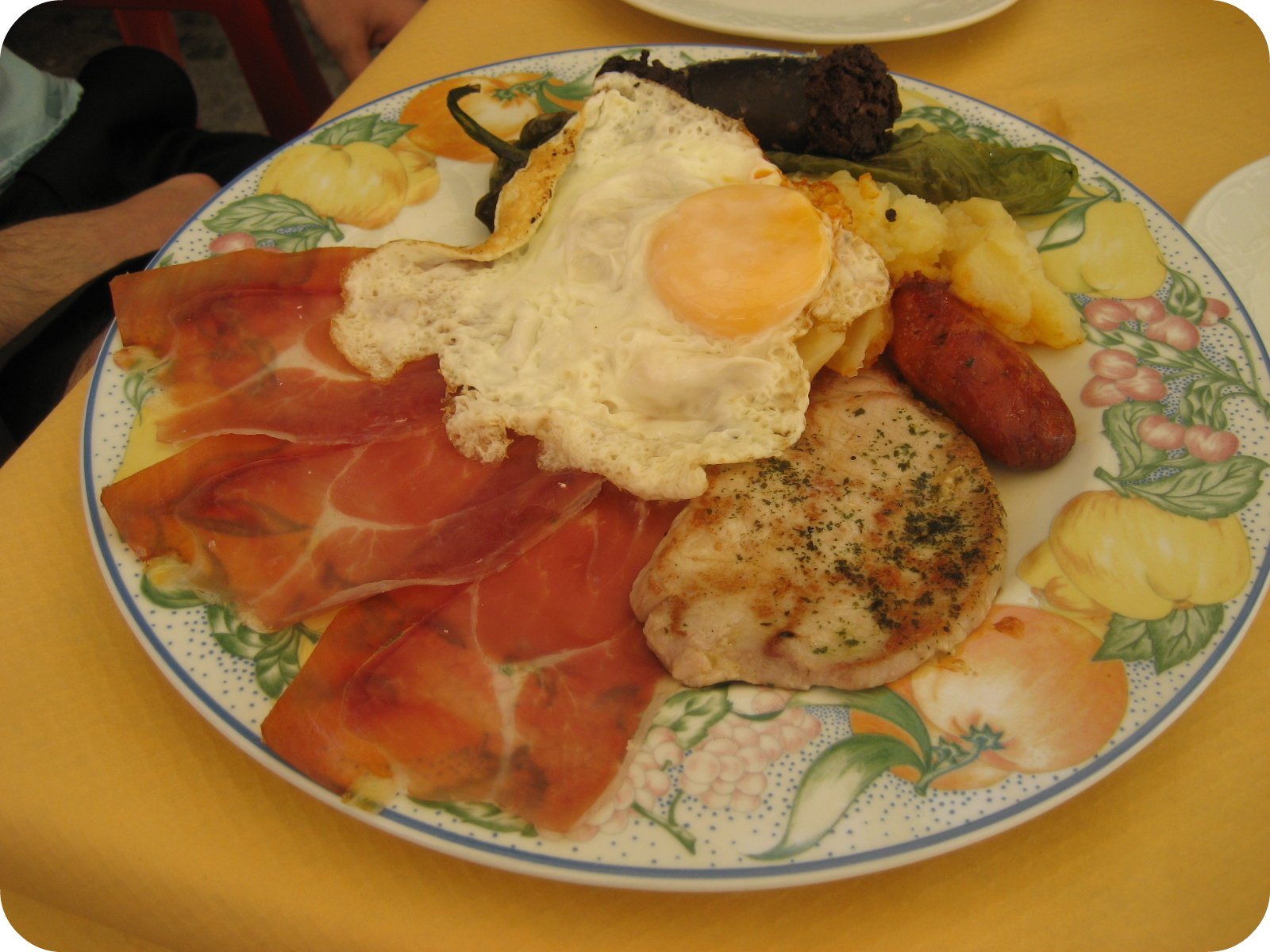
- Plato alpujarreño – the region's famous dish: black pudding (morcilla), lomo de orza (pork loin preserved in lard), sausage (longaniza), papas a lo pobre ("poor man's potatoes", slow-fried in olive oil), fried eggs and serrano ham. The dish originated from whatever families had in the pantry after the winter slaughter. It gained popularity in the 1970s when inns in the Poqueira villages began serving it to the first tourists – traditionally starting in Capileira.
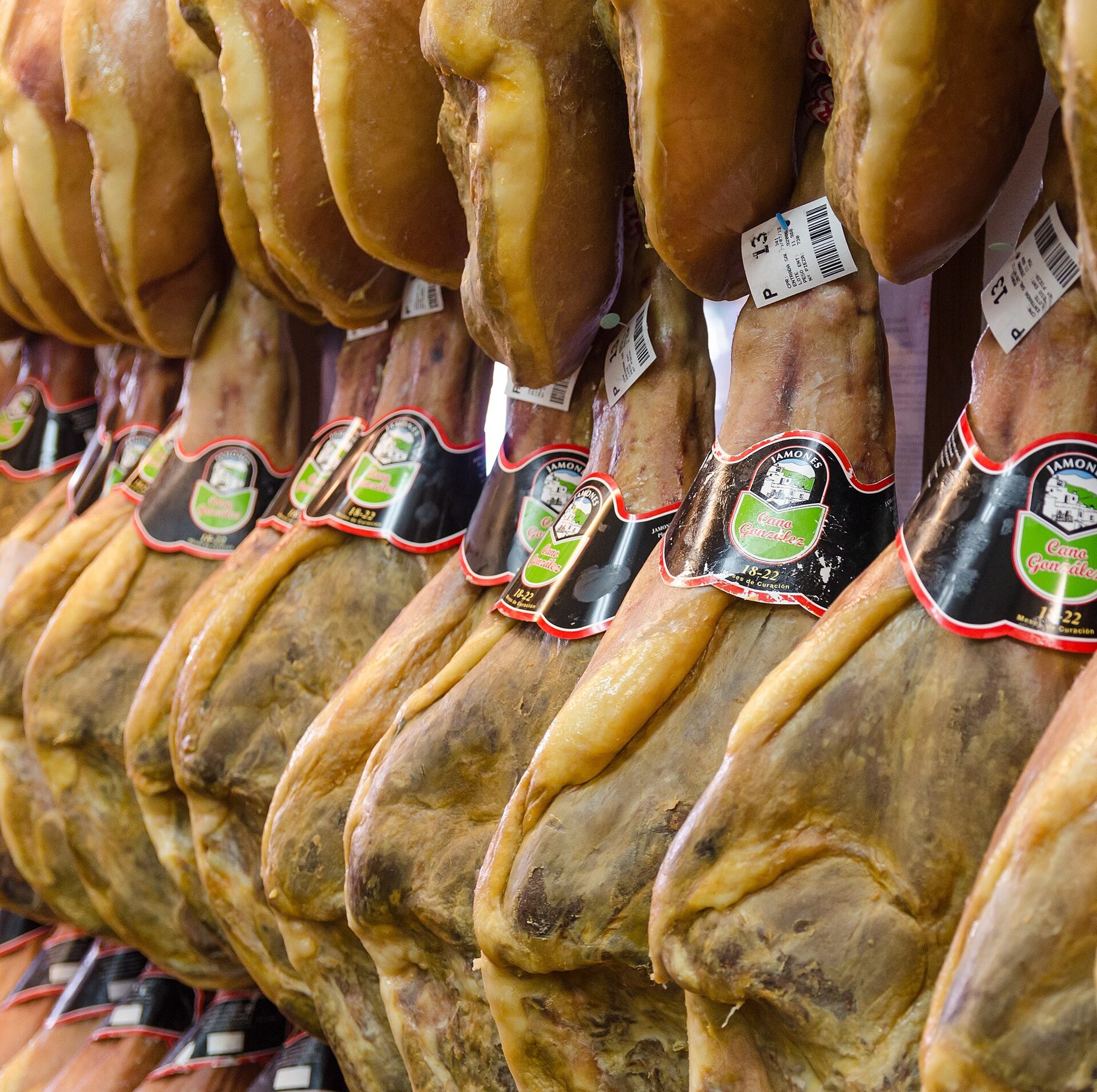
- Jamón de Trevélez – the cured ham has Protected Geographical Indication (PGI). Under the 2004 regulations, it must be air-cured in the parts of Trevélez, Juviles, Busquístar, Pórtugos, La Taha, Bubión, Capileira and Bérchules that lie above 1,200 metres. It is made from white pigs (crossbreeds of Landrace, Large White and Duroc) – not ibérico – and must cure for at least 14, 17 or 20 months depending on weight. Each ham receives a numbered seal (precinto) from the regulatory board.
- Migas – fried breadcrumbs or semolina, often served with sausage or peppers – a classic peasant dish. At the fiesta in Órgiva in September, they even host an international migas competition.
Where to eat? Restaurants and bars cluster around the main squares: Plaza de la Libertad in Pampaneira, Plaza de la Iglesia and the high street in Capileira, and Barrio Bajo in Trevélez, where ham shops and rustic inns sit side by side. We have not checked prices and do not recommend specific venues. At weekends and during holidays it is wise to eat early (before 14:00) or book a table. Read more about the regional cuisine under food traditions.
Toilets
- Pampaneira: public toilet on Plaza de la Libertad – free according to OpenStreetMap. This is the easiest stop on the trip.
- Lanjarón: OpenStreetMap lists a public toilet near the thermal spa. We do not know whether there is a charge.
- En route: the Mirador de Poqueira petrol station on the A-4132 just below Pampaneira has a toilet (open 7–23 according to OpenStreetMap).
- Órgiva, Bubión, Capileira and Trevélez: we have not found public toilets. Use the cafés and bars, and buy a coffee or a bottle of water.
Festivals and traditions
| When | Where | Facility |
|---|---|---|
| 17–20 January | Bubión, Capileira, Lanjarón, Órgiva | San Antón and San Sebastián. In Bubión and Capileira, chiscos – huge bonfires – are lit on the eve of San Antón |
| The Friday before Viernes de Dolores (March/April) | Órgiva | Cristo de la Expiración – a very long procession with plenty of rockets and fireworks |
| Easter | Órgiva | The Hecho en la Alpujarra fair featuring local crafts, cured ham and cheese from across the region |
| 3 May | Pampaneira | Santa Cruz – the celebration concludes with the entierro de la zorra, where a dummy packed with firecrackers is paraded and burnt |
| Last Sunday in April and 2nd Sunday in August | Capileira | Virgen de la Cabeza – featuring diablillos, youngsters dressed in masks and suits made of colourful fabric ribbons |
| Night of 23–24 June | Lanjarón | Carrera del Agua – for one hour at midnight everyone throws water over each other using buckets, hoses and bottles. Held since 1980 and declared a Fiesta de Interés Turístico Nacional in May 2026 |
| 5 August | Capileira and Trevélez | Virgen de las Nieves – a pilgrimage all the way up to Mulhacén |
| August | Pampaneira and Bubión | Summer fiestas. Bubión's is held on the penultimate weekend of August, originally introduced for those who had moved away |
| Late September or early October | Órgiva | Reales Ferias y Fiestas featuring a livestock market and migas contest |
| 1 November | Capileira | Mauraca – the chestnut festival. Since 1991, the town council has organised a large nocturnal mauraca in Plaza del Calvario with roasted chestnuts, aniseed liqueur and mistela |
| November | Trevélez | Feria del Jamón – ham fair with tastings and tours of the curing houses. According to a festival calendar, it will be held on 21–22 November 2026, though the council has not yet confirmed this |
The region also boasts its own folk music tradition. The Festival de Música Tradicional de la Alpujarra was first held in Yegen in 1982 and moves to a different village each year. Discover more celebrations on our fiestas page.
Maps and routes
Red star = Playa Tropical. Click on a point for the name and distance. Map data © OpenStreetMap.
Open the route in Google Maps
- Drive from Playa Tropical to PampaneiraApprox. 57 km, 1 hr 10 min via the A-7, A-44, A-346 to Órgiva and A-4132 into the Poqueira gorge. Free parking at the village entrance.
- The Vélez de Benaudalla route with stopsVélez de Benaudalla, the viewpoint at Rules Dam, and Órgiva – finally Pampaneira.
- The Lanjarón route with stopsThe gorge at Tablate, the thermal spa in Lanjarón, and Órgiva – finally Pampaneira. Approx. 71 km.
- Round trip: the Poqueira villages, Trevélez and homePampaneira, Bubión and Capileira, continuing to Trevélez and returning home. Approx. 3½ hours of pure driving time in total.
- Walk between the three villagesFrom the square in Pampaneira up to Bubión and Capileira. Steep – sturdy shoes recommended.
- Onwards to Gerald Brenan's YegenFrom Trevélez approx. 30 km east along winding roads, about 50 min.
The routes start at Playa Tropical. On mobile devices, they open directly in the Google Maps app, ready for navigation.
Good advice
- Set off early. The parking areas at the entrance to Pampaneira and Capileira fill up quickly on weekends and bank holidays – and lunchtime arrives fast.
- Pick just a few villages. Pampaneira, Bubión and Capileira are plenty for a relaxed day out. Trevélez and Lanjarón can easily wait for another trip.
- Visit on a Thursday. That way, you can start your day at the market in Órgiva.
- Wear good walking shoes. The village streets are steep, cobbled and full of steps, and water flowing down the central channels can make them slippery.
- Bring a jumper. Capileira and Trevélez sit at an altitude of around 1,500 m, making it noticeably cooler up here than down by the beach.
- Take your time driving. The mountain roads are narrow and winding. Head home before dark. If you are prone to motion sickness, sit in the front seat.
- Drink from the village fountains. In Lanjarón and many of the hillside hamlets, you will find public fountains with delightfully cold mountain water.
- Book the spa in advance. If you wish to visit the thermal baths in Lanjarón, be sure to phone ahead and book your slot – and do not forget a swimming cap.
The villages of the Poqueira gorge and Trevélez sit well over 1,000 metres above sea level, and snow and frost are by no means unusual during winter. In summer, sudden and violent thunderstorms can roll in over the Sierra Nevada. Always check the weather forecast before setting off, and turn back if roads become blocked.
Sources
- Balneario de Lanjarón (Relais Termal): Área termal – prices, opening times and regulations and Aquatherma
- Ministerio de Industria y Turismo 19-05-2026: Carrera del Agua is a Fiesta de Interés Turístico Nacional
- Órgiva Town Council: the Thursday market and mercadillos.org: Mercadillo de Órgiva
- Capileira Town Council: tourism, church, museum, PR-A 70 and buses
- Trevélez Town Council
- BOE 25-08-2004: Regulations for Jamón de Trevélez
- BOE 29-11-1982: Heritage listing of the Poqueira villages
- Junta de Andalucía: Ana Martínez – Telar de Jarapas Hilacar
- Wikipedia (es): La Alpujarra, Lanjarón, Órgiva, Pampaneira, Bubión, Capileira, Trevélez, Yegen, Gerald Brenan, Jarapa, Launa, Plato alpujarreño, Puente de Tablate, Embalse de Rules
- ALSA: timetables and tickets
- Distances and driving times: OSRM (OpenStreetMap)
- Coordinates: OpenStreetMap contributors (ODbL)
Krone amounts are converted at 1 € ≈ 7.46 kr. and rounded.