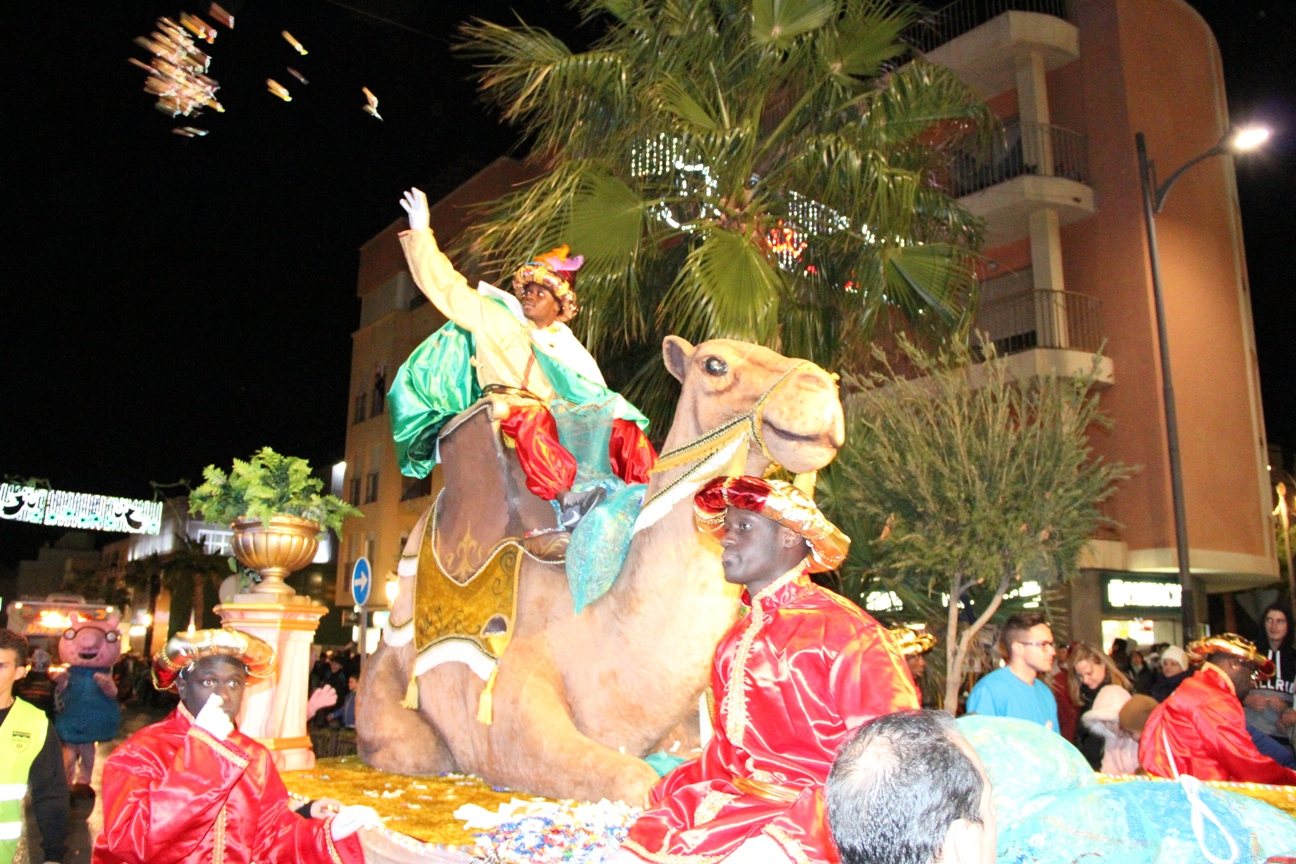
On the evening of 5 January, the Three Wise Men drive through Almuñécar and La Herradura on decorated floats, throwing sweets to the children. The parade in Almuñécar starts at the town stadium, just a 25-minute walk from Playa Tropical. The next morning, Spanish children find their presents – and 6 January is a public holiday, with most things closed.
← All fiestas in the fiesta calendar
What is being celebrated?
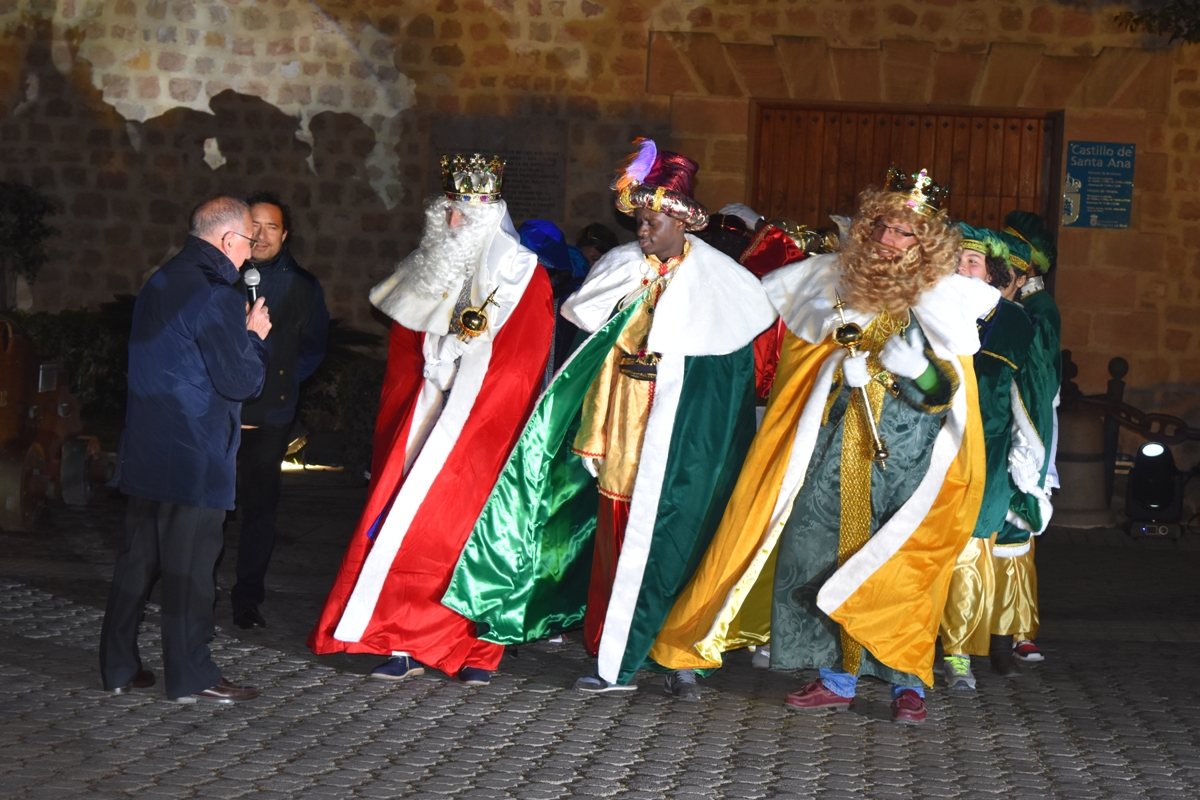
6 January is Epiphany – in Spanish Día de Reyes or Epifanía del Señor. According to the Bible, the Wise Men from the East followed a star to Bethlehem and presented the baby Jesus with gold, frankincense, and myrrh. In Spain, they are called Melchor, Gaspar and Baltasar, and it is they – not Santa Claus – who traditionally bring the children's presents.
During the night between 5 and 6 January, the Three Kings visit every home. The children have written wish lists to them in the weeks before, and on the morning of the 6th, the presents are waiting. If you haven't been good, the joke goes that you might receive coal – nowadays this is carbón dulce, sweet black sugar coal, which you can buy at the baker's.
The evening before, the kings arrive in town in a parade, a cabalgata. The oldest known cabalgata was held in Alcoy in 1866 and has run every year since 1885. In Granada, the art association Centro Artístico organised a parade in 1912 to collect toys for poor children. Today, almost every Spanish town has its own cabalgata, and the national TV channel La 1 has broadcast the parade from Madrid every year since 1964.
When is the next one?
The parade is always on the evening of 5 January. The next one will therefore be on Tuesday 5 January 2027, and present-giving day is Wednesday 6 January 2027, which is an official public holiday throughout Andalusia (Junta de Andalucía calendar for 2027).
Times, routes, and themes for 2027 have not been published as of October 2026. In 2026, the municipality presented the parade on 30 December, and La Herradura published its programme on 2 January. Keep an eye on local media and the municipality's channels between Christmas and New Year.
The weather can change everything. In 2025, the parade in Almuñécar was brought forward by an hour to 4:30 pm because rain was forecast for the evening. In 2026, the municipality decided on 4 January to move both the Almuñécar and La Herradura parades to 6 January at 12:00 noon due to the weather forecast. Therefore, check the time again on the day itself.
The programme in Almuñécar
Here is the programme as presented by the municipality for January 2026. It gives a good idea of what to expect – but 2027 may be different.
| When | Facility |
|---|---|
| In the weeks before | The children hand in their wish lists. The kings' messenger, Heraldo Real, walks through the town with the municipal brass band (2 January in 2026) |
| 5 January at 5:30 pm | The parade sets off from the stadium – with fireworks at the start |
| Along the way | Fireworks by the fountain in Plaza de la Carrera |
| Upon arrival | The parade ends at the stadium – once again with fireworks |
| Night of 5-6 January | The kings bring the presents |
| 6 January | Public holiday: presents, family lunch and roscón |
The route
The parade starts at Estadio Municipal Francisco Bonet and runs along Puerto de la Cruz, Calle Larache, Avenida Fenicia and Carrera de la Concepción out onto Avenida Costa del Sol. From there it returns to Carrera de la Concepción and continues along Avenida Juan Carlos I, Calle Mariana Pineda and Calle Tetuán back to the stadium.
What takes part?
In 2026, the parade featured 10 floats and 11 dancing and musical groups (pasacalles). Each year has its own theme – in 2026 it was Disney films. The first part of the parade was about the theme, and the second part was the kings' own procession:
- Heraldo Real – the kings' messenger, who collects the final wish lists
- Estrella de la Ilusión – the star that shows the way
- Melchor, Gaspar and Baltasar – each on their own float
- Carboneros – the coal men who hand out sweet coal to the children
The municipality expected to throw around 10,000 kilos of sweets, over 5,000 toys, and around 5,000 balls from the floats. The kings are played by local residents. In 2026, they were a local metalworker, a restaurateur, and a Senegalese immigrant. Participants in the parade included the municipal music and dance school, a batucada drum group, the rhythmic gymnastics club, and young people from the church brotherhoods.
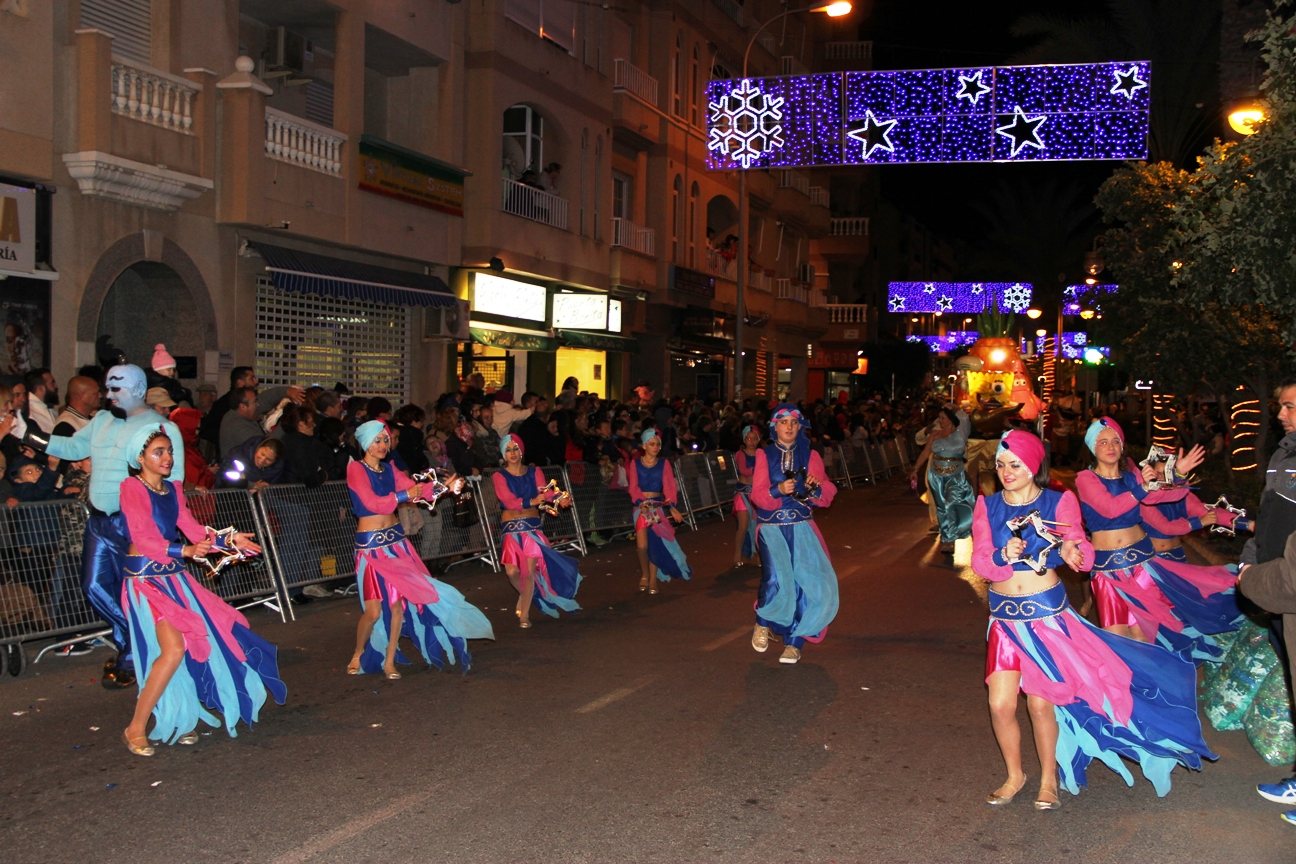

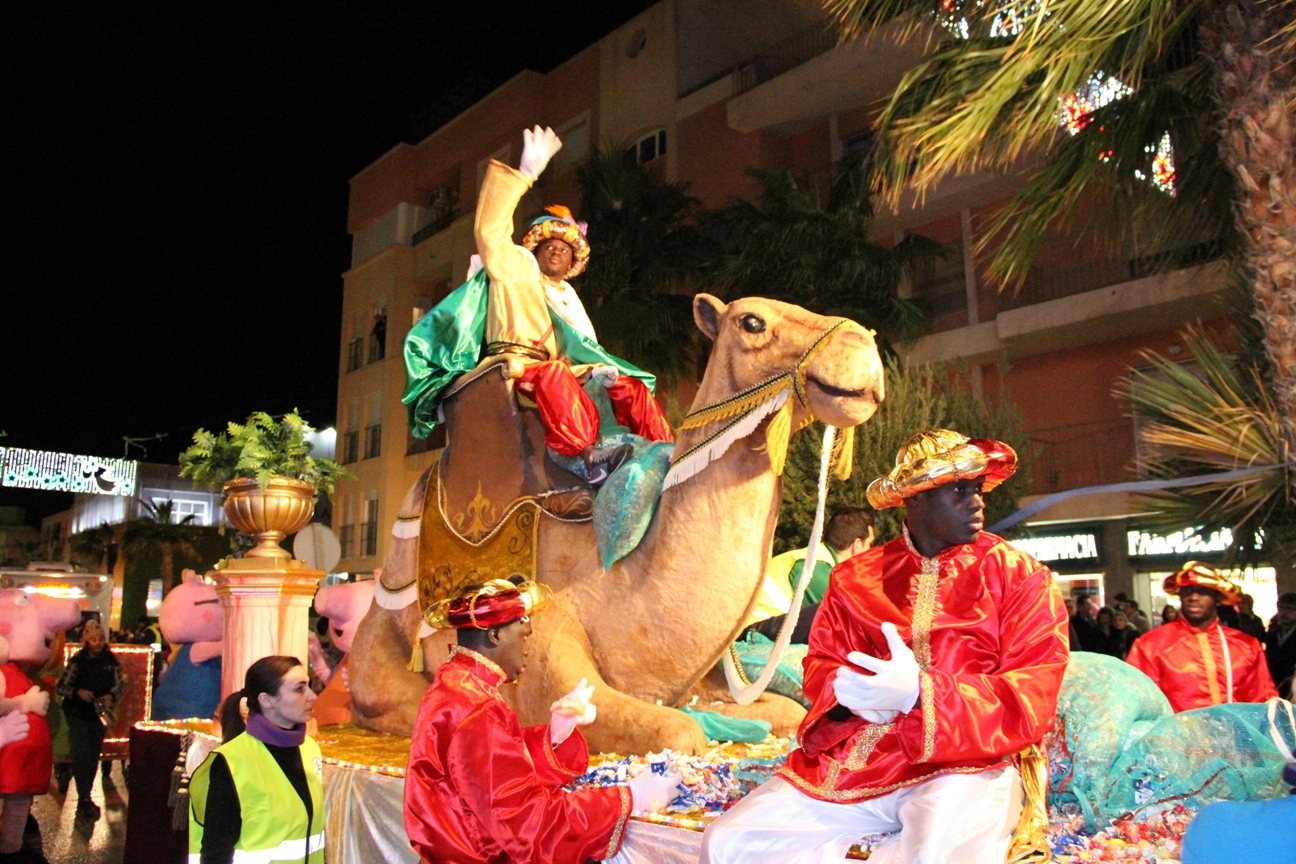
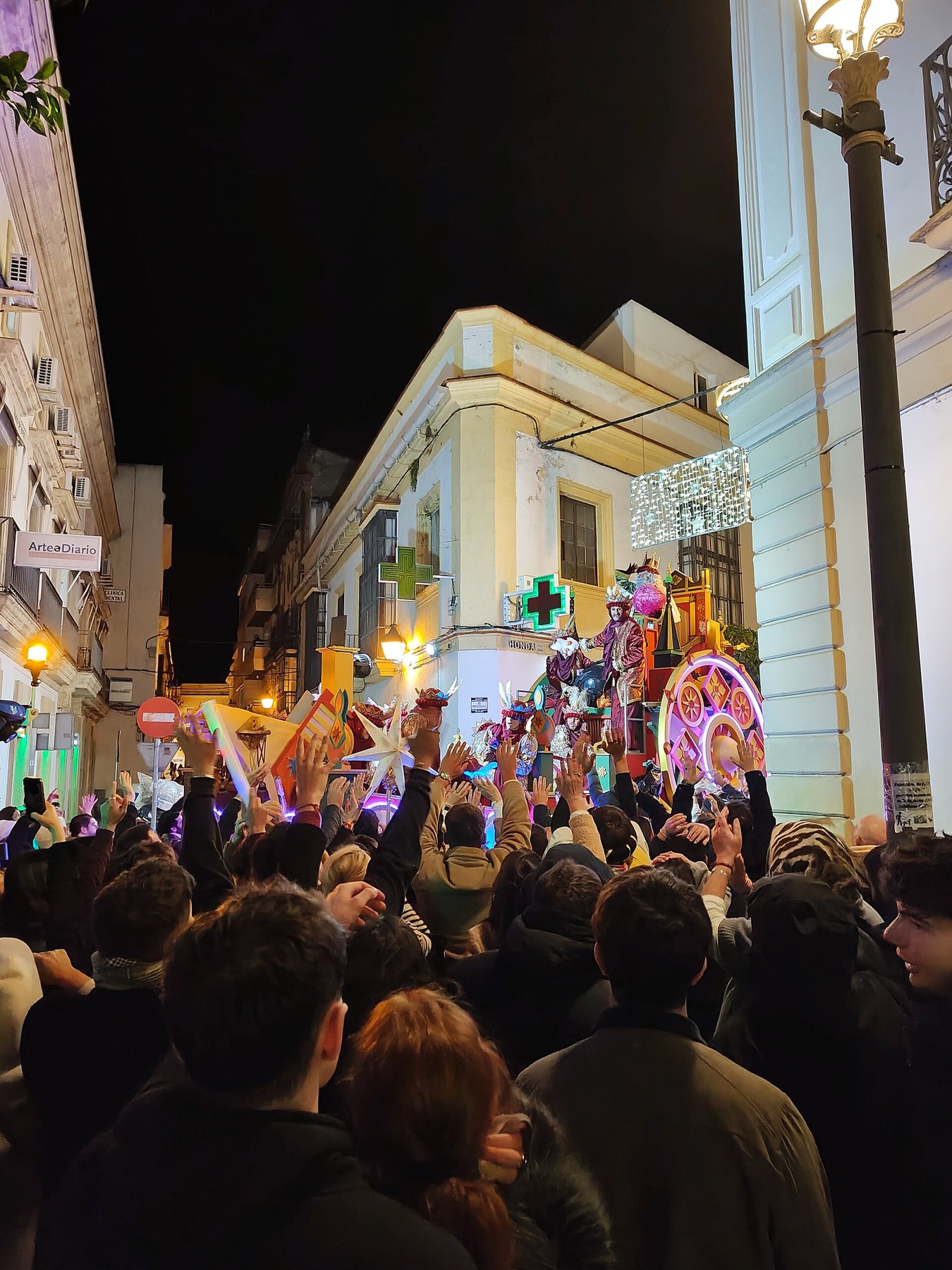
We have not found any free images from the parade in Almuñécar. The photos are from Roquetas de Mar in the neighbouring province of Almería and from Jerez de la Frontera, where the parade is very similar.
La Herradura
La Herradura has its own, smaller parade on the same evening. In January 2026, it was scheduled to run at 5:00 pm from La Herradura's sports hall (Pabellón de deportes) with six floats and dancers from a local dance school. The route runs along the seafront Paseo Andrés Segovia to Barranquillo and up Calle Alhambra to Plaza de la Independencia by the church. Here the kings hand out presents to the children. Local associations and residents lend a hand.
In 2025, the route was shortened and ended at Plaza Nueva. In 2026, La Herradura's parade was also moved to 6 January at 12 noon due to the weather.

The other towns on the coast
Almost all towns have their own parade, so you can also see it in neighbouring towns. The times here are from January 2025 – check them again for 2027:
- Motril: The kings came ashore at the fish market (Lonja) in the port at 4:15 pm and were given the key to the city. The parade started at 5:30 pm from Calle Aguas del Hospital (brought forward an hour due to rain).
- Salobreña: The parade started from the beach at 6:30 pm with 9 floats (also brought forward an hour). See Salobreña.
- Granada: The city's parade is one of the oldest in Spain (since 1912). See Granada and the Alhambra.


Presents on 6 January
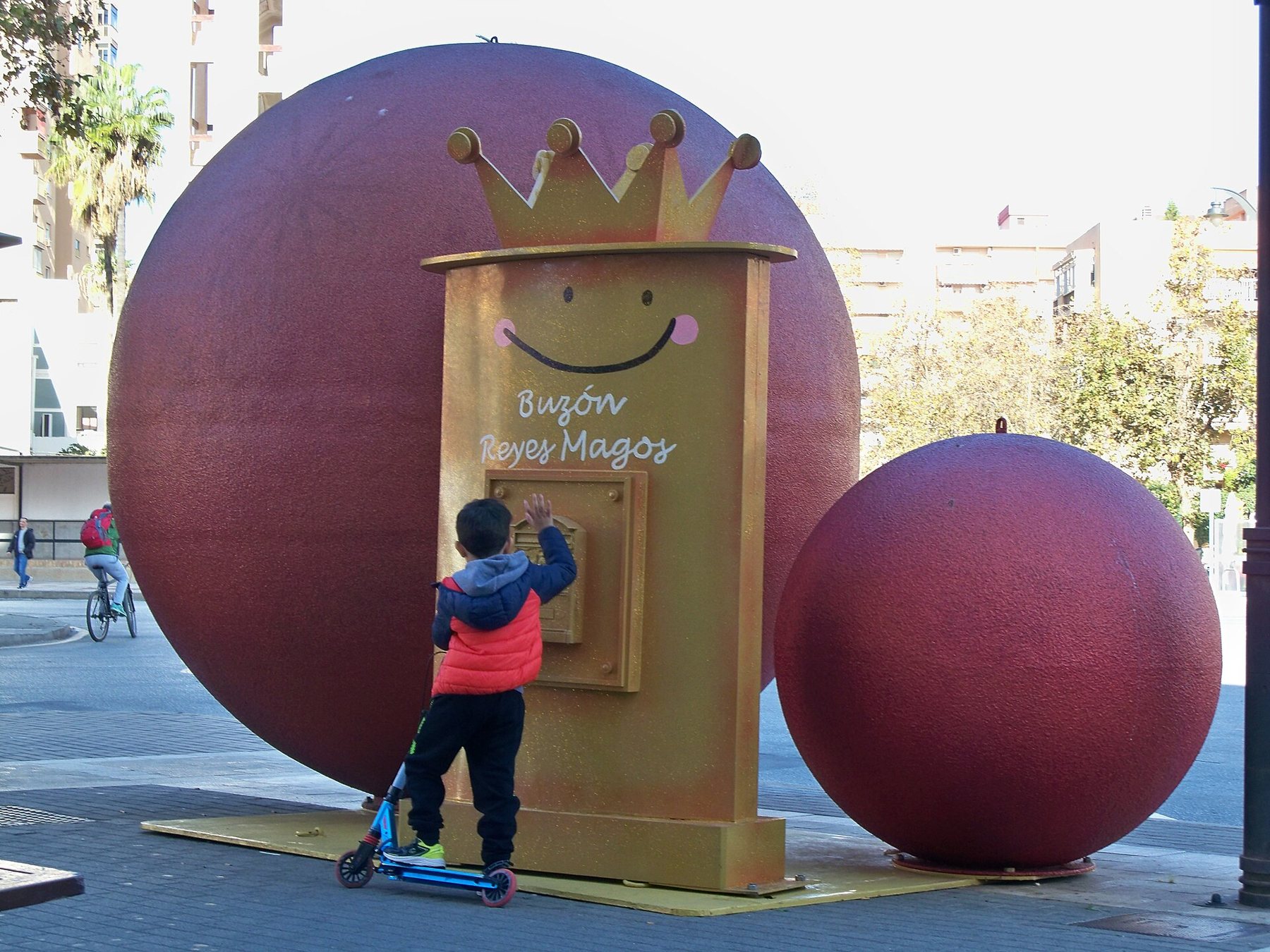
For Spanish families, 6 January is when the presents arrive – although many nowadays also give gifts on Christmas Eve. Children write wish lists to the kings and post them in special letterboxes, give them to the kings' messenger, or hand them up to the Heraldo Real in the parade. At night the kings arrive, and in the morning the presents are waiting. The day is celebrated with a family lunch and roscón.
Food and drink: roscón de reyes
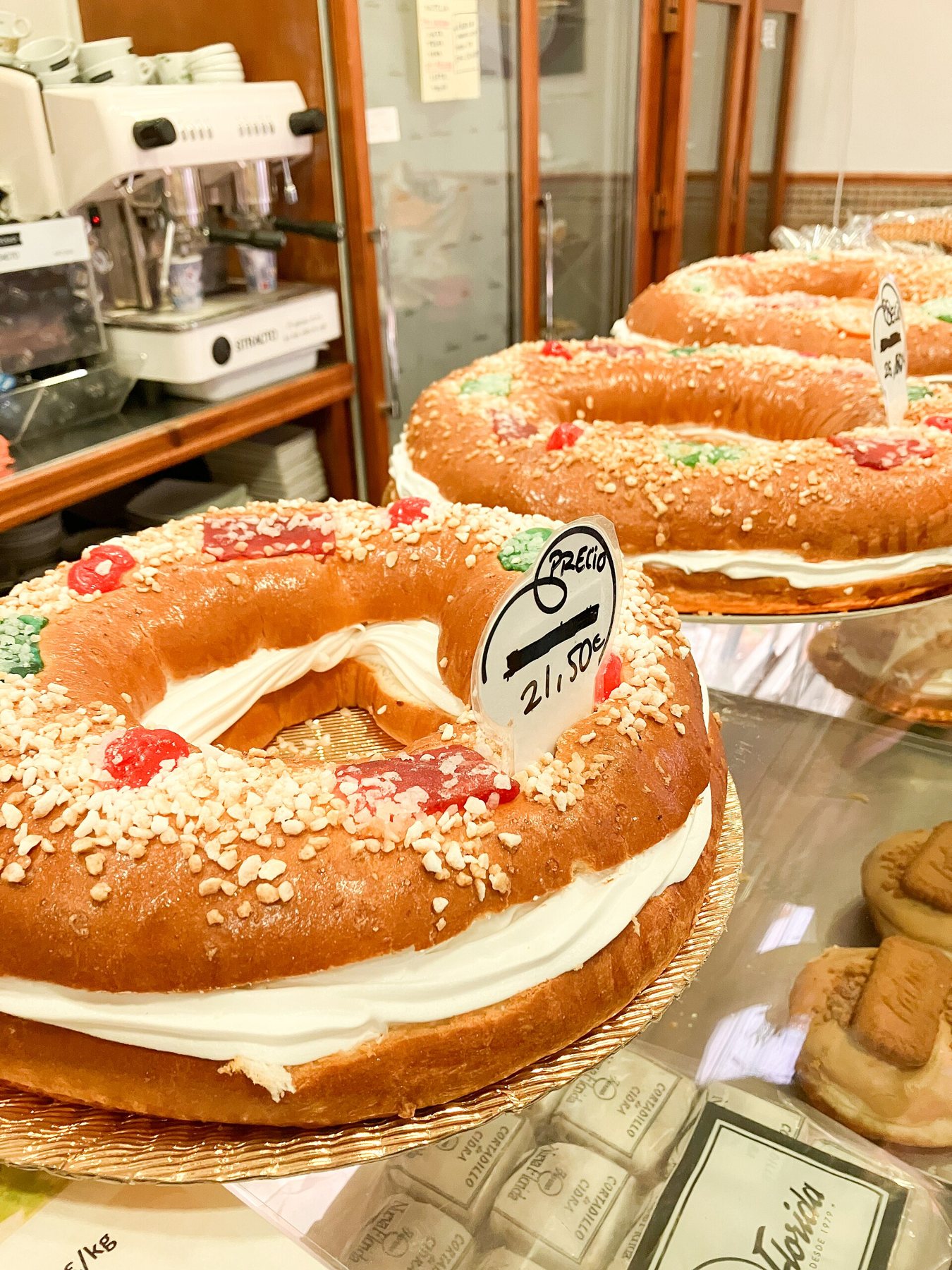
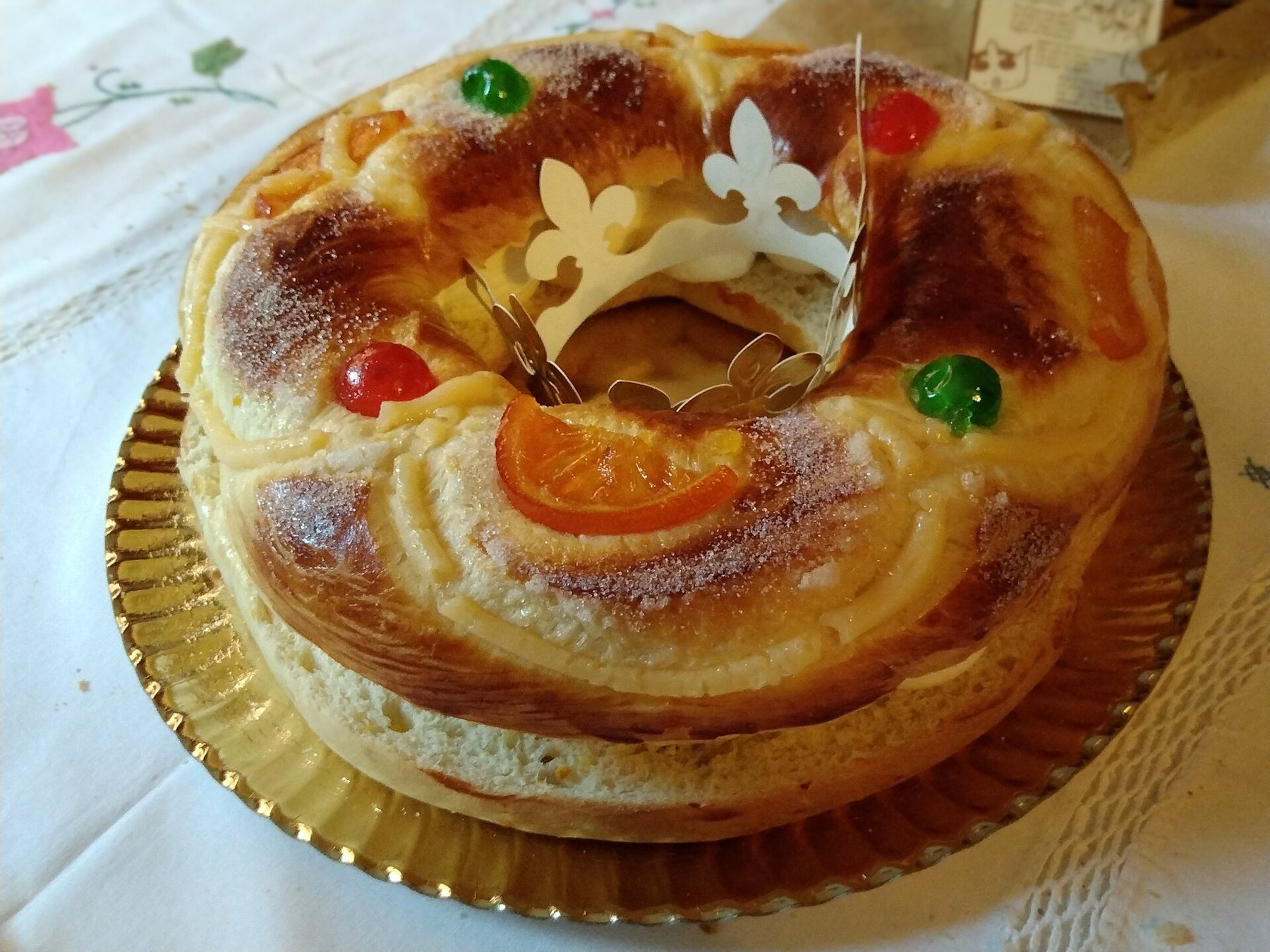
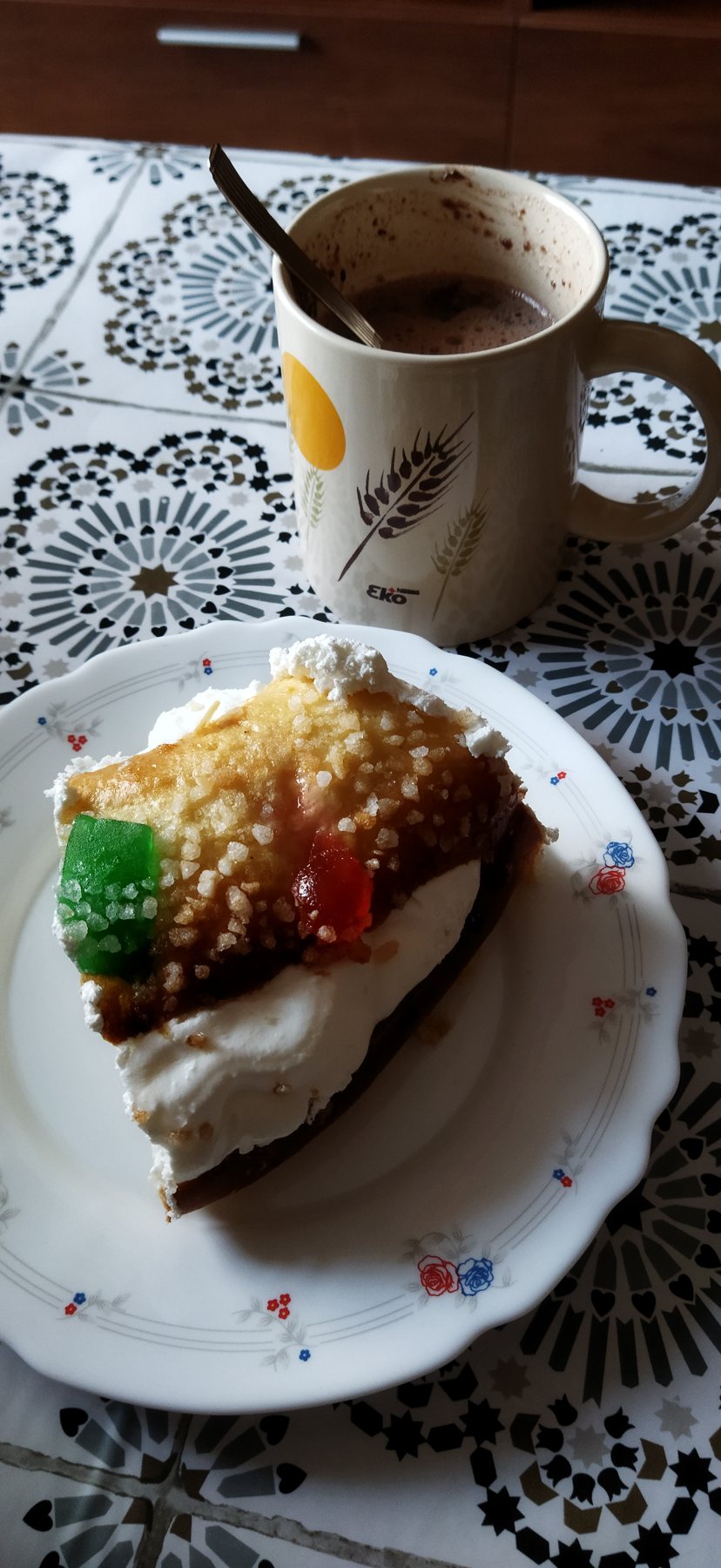
The Epiphany cake is the roscón de reyes: a large, ring-shaped cake made of sweet yeast dough, often scented with orange blossom water and decorated with coloured, candied fruits, almonds, and sugar. Many are sliced open and filled with whipped cream, custard, truffle, or chocolate. It is eaten on the evening of the 5th and on the day itself, 6 January, ideally with a cup of thick hot chocolate.
Hidden inside the cake are two things: a small figurine and a dried bean (haba). Whoever gets the figurine becomes the king or queen of the day and gets to wear the paper crown. Whoever gets the bean is traditionally expected to pay for the cake. The cake came to Spain from France, and it was first mentioned in a Spanish newspaper in 1848.
You can buy roscón at bakeries and supermarkets in the days leading up to it. It is a good idea to order in advance if you want one from a specific bakery – we have not checked opening hours for 6 January.
How to get there
On foot (the easiest way)
From Playa Tropical it is approx. 1.8 km – about a 25-minute walk west to the stadium where the parade starts and ends. You can also position yourself somewhere along the route, e.g. at Avenida Fenicia or Plaza de la Carrera. Remember a torch or your mobile phone for the walk back in the dark. The buttons below the map open the route from Playa Tropical directly in Google Maps.
By car
It is about 2 km to the stadium and a 6-minute drive, but the streets along the route are closed while the parade is running. We have not found any parking instructions from the municipality. We suggest:
- Parking El Altillo – a paid underground car park in the centre, open 24 hours a day according to OpenStreetMap. From here you walk a couple of hundred metres up to Calle Mariana Pineda.
- The market square at Paseo de Blas Infante – a large square (approx. 300 spaces according to OpenStreetMap) where the Friday market is held. It is located right by the route, so it may be full or closed off. See Parking.
To La Herradura
Approx. 9.5 km and a 16-minute drive along the N-340. Park well before the parade starts and walk down towards the seafront or up to Plaza de la Independencia. Buses run between Almuñécar and La Herradura – see Buses. We have not been able to confirm when the last bus runs on 5 January, so check the timetable or take a taxi home.
Toilets
We have not found any information about mobile toilets along the route. OpenStreetMap shows two public toilets at Avenida Fenicia, right by the route, but we do not know if they are open in the evening. The safest option is to go to a café or bar in the centre and buy a coffee. Use the toilet before you find your spot – it is hard to get back once you've lost it.
Practical info
- Crowds: The parade is for families with children, and the whole town is out on the streets. Children stand at the front, and when sweets are thrown, there is pushing and shoving. If you are unsteady on your feet, find a spot slightly away from the kerb or at a corner where there is less pressure.
- Sweets can hurt: Sweets, balls, and toys are thrown hard from the floats. Many Spaniards bring an umbrella and turn it upside down to catch sweets in it.
- Fireworks: There are fireworks at the stadium and by the fountain in Plaza de la Carrera – bear this in mind if you have a dog with you.
- Clothing: January evenings on the coast can be chilly and damp. Wear a jacket, and bring rainwear if rain is forecast.
- Arrive in good time: If you want a good view, be there half an hour before the start. The parade takes a long time, so further along the route there is no need to arrive early.
- Accessibility: The route in Almuñécar goes along normal car streets and pavements, so you can watch with a rollator or wheelchair – but it gets crowded. Choose a spot close to a corner so you can get away easily.
- The 6 January public holiday: Most things are closed – shops, banks, post offices, and public offices. Do your shopping by the 5th at the latest, and do not rely on the supermarket being open on the day itself. Also keep an eye on the Sunday and public holiday bus timetable.
Maps and routes
Red star = Playa Tropical. Click on a point for the name and distance. Map data © OpenStreetMap.
Open the route in Google Maps
- Walk from Playa Tropical to the start of the paradeApprox. 1.8 km, a 25-minute walk west to Estadio Francisco Bonet.
- Walk along the route and back againStadium, Avenida Fenicia, Plaza de la Carrera and Calle Mariana Pineda – and back to Playa Tropical.
- Drive to Parking El AltilloApprox. 2.2 km, 6 minutes. Park in the underground car park and walk up to the route – the streets along the parade are closed.
- Drive to the parade in La HerraduraApprox. 9.5 km, 16 minutes along the N-340. The seafront and Plaza de la Independencia, where the kings hand out presents.
The routes start at Playa Tropical. On mobile devices, they open directly in the Google Maps app, ready for navigation.
Good advice
- Check the time on the day. Two years in a row, the parade has been moved due to the weather – in 2026 even to the following day.
- Walk there. It is only a 25-minute walk, and you will avoid closed streets and parking chaos.
- Stand by Plaza de la Carrera. There are fireworks here along the way, and there are cafés nearby.
- Bring a bag. If you have grandchildren with you, they can collect sweets in it – or in an upside-down umbrella.
- Buy roscón in advance. On 6 January, most shops are closed.
- Celebrate New Year first. Read about New Year's Eve and the 12 grapes – and see all the town's fiestas on the fiesta page.
Sources
- 101TV 31-12-2025: The municipality's presentation of the 2026 parade – time, route, floats, fireworks, Heraldo Real
- El Independiente de Granada: Almuñécar and La Herradura move the parade to 6 January (2026)
- El Faro de Motril 04-01-2026: The parade on 6 January at 12 noon
- Diario Sexitano 02-01-2026: La Herradura's parade – time and route
- COPE 04-01-2025: Parades in Motril, Salobreña and Almuñécar brought forward by an hour
- Almuñécar Hoy: The route and La Herradura's shortened route in 2025
- BOJA: Andalusian public holidays 2027 (decree 84/2026)
- Wikipedia (es): Cabalgata de Reyes Magos
- Wikipedia (es): Roscón de reyes
- Coordinates: OpenStreetMap contributors (ODbL)