

← All articles on day trips to Morocco
Can it be done in a day?
Tétouan: yes, but it makes for a long day. From Playa Tropical you drive just under 3 hours to Algeciras, sail an hour to Ceuta, take a taxi to the border, walk across and drive about 40 minutes to Tétouan. The journey home takes just as long. If things go well at the border, you get 4–5 hours in Tétouan and are home by midnight. If they go badly, you will be queuing for hours.
Chefchaouen: no. The town is about 100 km from the border at Tarajal and 126 km from the port of Tanger Med along mountain roads. From Playa Tropical it takes 7–8 hours each way if everything goes to plan. You would only have an hour or two to see the town. Even Civitatis' tours from Tangier, which is closer, take 8 hours there and back.
Our advice: Take at least two days, and spend a night in Tétouan or Chefchaouen. If you have time, take three days: one night in Algeciras before the ferry and one night in Chefchaouen. Or buy an organised tour that includes ferry, coach, guide and hotel (see below).
The ferry: Algeciras–Ceuta or Algeciras–Tanger Med
There are two ways from Algeciras to Tétouan and Chefchaouen. The shortest goes via Ceuta, a Spanish city on the African coast. From there you walk across the land border into Morocco at Tarajal. The other goes by ferry to the big Moroccan port of Tanger Med, where passport control takes place in the port.
| Via Ceuta | Via Tanger Med | |
|---|---|---|
| Ferry port | Algeciras, about 224 km from Playa Tropical | Algeciras, about 224 km from Playa Tropical |
| Crossing | Approx. 1 hour | About 1½ hours or more |
| Ferry companies | Baleària, DFDS and Naviera Armas according to the ticket sites | Baleària, DFDS, AML and others |
| The border | The land border at Tarajal – on foot, queues can be long | Passport control in the port |
| To Tétouan | About 42 km from the port in Ceuta | About 61 km, about 1 hour |
| To Chefchaouen | About 100 km from the border | About 126 km, just over 2 hours |
| Best for | Foot passengers and organised tours | Those who want to avoid the land border and have a driver or car in Morocco |

Algeciras–Ceuta
The crossing takes about 1 hour. DFDS says on its own website that the route takes about 60 minutes. The ticket sites also mention Baleària and Naviera Armas, and in summer 2026 there were many departures every day, the first at around 7 in the morning. We have not been able to read the ferry companies' own winter timetables or find a reliable fare for foot passengers – the ticket sites disagree. Check departures and fares with the ferry companies before you plan your day. In winter, storms in the strait can cancel sailings.
Remember: Ceuta is Spanish, but the city is not part of the EU customs territory. When you sail back, the police check passengers' ID in the port of Ceuta (Euronews reported on 15-10-2026 on arrests at precisely that checkpoint), and in Algeciras you go through Spanish customs. Keep your passport ready the whole way.
The border at Tarajal
From the ferry terminal in Ceuta it is about 5 km and 10 minutes by taxi to the El Tarajal border crossing. From here you walk across to the Moroccan border town of Fnideq. The border is open, but it has had a turbulent year:
- On 10 April 2026 Spain introduced the EU's new digital border control (EES) at Tarajal. According to El Faro de Ceuta, EU citizens go through automatic passport gates, while citizens of non-Schengen countries must give fingerprints and a photo.
- During the Muslim holiday in May 2026 there were waits of up to 5–8 hours by car (El Faro de Ceuta and The Objective, 24-05-2026).
- On 30 July 2026 thousands of migrants crossed the border into Ceuta in a single day, and Morocco deployed more police at Fnideq.
- On 31 October 2026, the weekend around All Saints' Day, there were queues of up to 3–4 hours to cross the border into Morocco, according to EFE.
The newspapers' figures are for the car queue. We have not been able to find official figures for how long pedestrians wait. According to Ceuta Actualidad (07-07-2026), toilets and shade have been built at the pedestrian entrance. Avoid weekends and public holidays – both Spanish and Moroccan – and keep an eye on the local newspapers in Ceuta before the trip. Do not take photos at the border.

On the Moroccan side there are taxis that go to Tétouan. A travel blog mentions 20 dirhams per person in a shared grand taxi from Tétouan to the border, but we have not been able to confirm this. Always agree the price before you get in.
Algeciras–Tanger Med
From Algeciras the ferries also sail to Tanger Med. Here you avoid the land border, but the port is a long way from everything: 61 km to Tétouan and 126 km to Chefchaouen. It works best if you have booked a driver or are on a tour that picks you up at the port. Read more about the port and the ferry from Tarifa in day trip to Tangier.
Organised tours
The easiest way to see both towns is to buy a tour that includes ferry, coach, guide, hotel and lunch. We have only included tours whose content we could read on the provider's or reseller's own website (02-11-2026):
- Nattivus – "Algeciras to Morocco Tour in 2 days" (Tétouan and Chaouen): meeting point at the port in Algeciras at 9.00, ferry to Ceuta at 10.00. Saturday: tour of Ceuta, the border, Tétouan with Place Hassan II, the royal palace, the Jewish quarter, the souk and the medina, lunch and hotel with dinner. Sunday: Chefchaouen with the kasbah seen from outside, Uta el-Hammam and Ras el-Maa, lunch and free time. Back in Algeciras at about 20.30–20.45. Included in the price: fast ferry, coach, local guides in Tétouan and Chefchaouen, one night half board, lunches and travel insurance. Drinks are not included. From 177 US dollars per person in a double room at a 3-star hotel, single room 202 dollars. The tour runs with a minimum of 2 adults. You must give your passport number and expiry date when you book.
- Nattivus – "Malaga to Morocco Tour in 3 days" (Tétouan, Tangier and Chaouen): departure at 6.00 from the bus stop by the town hall in Málaga (Avenida Cervantes 4), by coach to Algeciras and ferry to Ceuta. Friday Ceuta and Tétouan, Saturday Asilah, Tangier and Cap Spartel, Sunday Chefchaouen. Back in Málaga at about 23–24. From 340 US dollars per person in a double room. According to the website, the price goes up by 18 € (≈ 134 kr.) in July and August.
- Nattivus – Tarifa–Chefchaouen in 3 days: ferry Tarifa–Tangier, transfer to a hotel in Chefchaouen and two nights with breakfast, from 276 US dollars. No guide.
- Civitatis – excursions from Tangier and Tétouan: If you are already staying in Tangier, you can take a day trip to Chefchaouen and Tétouan with a Spanish-speaking guide (11½ hours, from 60 € (≈ 448 kr.)) or to Chefchaouen only (8 hours, from 42 € (≈ 313 kr.)). From Tétouan there is a trip to Chefchaouen with an English-speaking guide (8 hours, from 50 € (≈ 373 kr.)). Food and drink are not included. Civitatis is a reseller, and its pages do not say who runs the tours.
None of the tours we have found pick up in Almuñécar, Nerja or Motril. From Playa Tropical it is about 80 km and just over an hour to Málaga, and just under 3 hours to Algeciras. The tour from Algeciras works best if you stay overnight in Algeciras the evening before. Private tours from Málaga are sold on travel portals, but typically cost over 1,500 € (≈ 11,190 kr.) per person.
A realistic trip – timetable
The ferry times are examples – check the actual departures with the ferry company. In winter, Morocco is on the same time as Spain.
A: Two days on your own (recommended)
| Time | Facility |
|---|---|
| Day 1, 5.30 | Drive from Playa Tropical to Algeciras (just under 3 hours) and park at the port |
| 9.00–10.00 | The ferry to Ceuta |
| 10.15–12.00 | Taxi to Tarajal and across the border on foot. It can take much longer |
| 12.00–12.45 | Taxi from Fnideq to Tétouan |
| 13.00–17.00 | Lunch and the medina in Tétouan: Place Hassan II, the souk and Bab el-Okla |
| 17.00–18.30 | Taxi or bus to Chefchaouen. Overnight in Chefchaouen |
| Day 2, morning | Chefchaouen: Uta el-Hammam, the kasbah, the blue streets and Ras el-Maa. Walk up to the Spanish Mosque for the view |
| 13.00–15.00 | Taxi back to the border at Tarajal (approx. 100 km) |
| 15.00–17.00 | Across the border and a taxi to the port in Ceuta |
| 18.00–19.00 | The ferry to Algeciras, then drive home (arriving around 22.00) – or stay overnight in Algeciras |
B: Tétouan only, in one day
Leave Playa Tropical at 5.00, ferry at 9.00, in Tétouan around midday, back across the border by 16–17 at the latest and ferry at 18–19. Home around 22–23. That is about 450 km of driving, two ferry crossings and two border crossings in one day. It can be done on an ordinary weekday, but a long queue at the border will ruin the day. We do not recommend it if you are the only driver.
How to get there
By car to Algeciras
Take the A-7 towards Málaga and continue past Marbella and Estepona to Algeciras. West of Málaga you can choose the free A-7 or the AP-7 toll motorway, which saves time. It is about 224 km and just under 3 hours. The buttons below the map at the bottom open the route from Playa Tropical directly in Google Maps – to the ferry in Algeciras, all the way via Ceuta to Tétouan and Chefchaouen, and via Tanger Med.
Parking in Algeciras
At the ferry terminal is the covered COPARK Estación Marítima (long-stay parking), open around the clock. On Parclick one day cost 18.75 € (≈ 140 kr.) and three days 50 € (≈ 373 kr.) (checked 02-11-2026). About 10 minutes' walk from the ferry is Parking Mercado, which is a little cheaper. Leave the car in Spain – in Morocco you are best off using taxis or buses. See also parking.
By bus
There is no direct bus from Almuñécar to Algeciras. ALSA runs from Almuñécar to Málaga, and from there several companies run to Algeciras. Allow most of a day. See buses.
In Morocco: taxi and bus
Between the towns there are the large shared grand taxis, which leave when they are full, and buses from the bus stations. Tétouan has a CTM bus station just south of the medina. We have not been able to confirm timetables or prices. The Danish Ministry of Foreign Affairs advises using only authorised taxis and not accepting offers of lifts from strangers.
Sights along the way
- Costa del Sol: the motorway follows the coast past Málaga, Marbella and Estepona. If you want to see more of Málaga, read day trip to Málaga.
- The Rock of Gibraltar: You see it from the motorway around Algeciras and again from the ferry as you sail out of the bay.
- The Strait: From the ferry you see Europe and Africa at the same time, and in clear weather you can see the Rif Mountains all the way across.
- Ceuta: If you have time, take a look at the town walls and the waterfront. Read more in Ceuta – a Spanish town in Africa.
All along the coast, including at Playa Tropical, stand the old watchtowers, built as a defence against pirates from North Africa. For several hundred years Tétouan was one of the pirates' port towns, and beneath the medina lie the old dungeons. Read more in pirates and watchtowers.
Tétouan – the white town
Tétouan lies between the Rif Mountains and the Mediterranean, about 40 km south of Ceuta. The city has over 400,000 inhabitants and is called La Paloma Blanca in Spanish, the white dove. It was destroyed by the Castilians in 1399. After the fall of Granada in 1492 it was rebuilt by refugees from al-Andalus – Muslims and Jews from southern Spain – led by Ali al-Mandri. According to Spanish Wikipedia, Tétouan is the town in Morocco with the most Andalusian features, and you can see it in the white houses, the narrow streets and the tiled fountains.
From 1913 to 1956 Tétouan was the capital of the Spanish protectorate in northern Morocco. That is why there is a Spanish quarter, the Ensanche, just outside the medina, and many people still speak Spanish.
The medina – World Heritage
Tétouan's medina was added to UNESCO's World Heritage List in 1997 under the name "Medina of Tétouan (formerly known as Titawin)". UNESCO highlights that it was rebuilt by Andalusian refugees, and that its art and architecture clearly show the Andalusian influence. The medina is surrounded by a wall with seven gates and is still a living quarter with homes, workshops and markets.
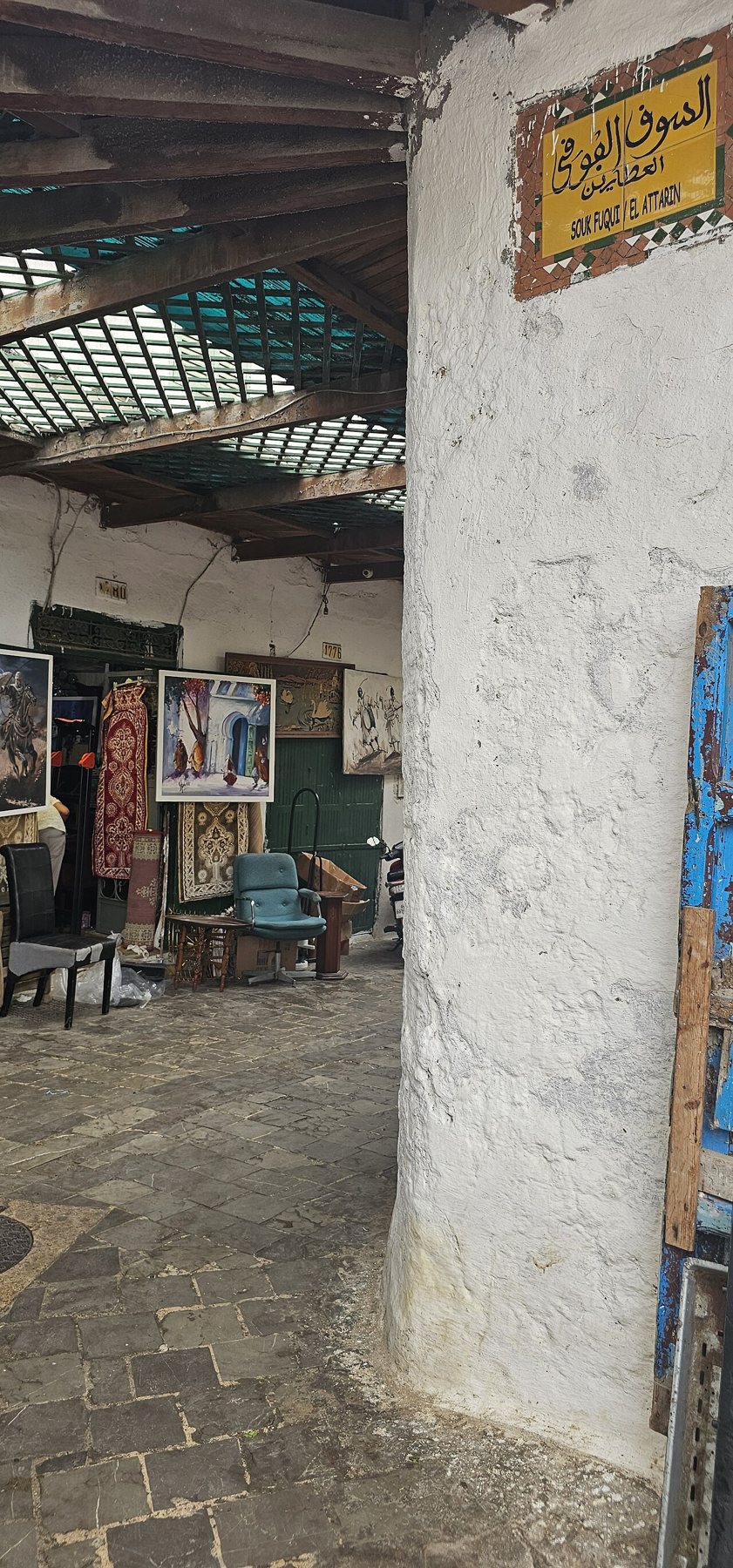
One of the best-known gates is Bab el-Okla (also Bab Okla) on the east side of the medina. According to the sign on the gate, it was built in the first part of the 16th century. Right by the gate is a fountain with green and blue tiles, a small museum of Moroccan art and crafts, and Tétouan's school of arts and crafts (Escuela de Artes y Oficios) from the protectorate era.

Place Hassan II and the Royal Palace
On the west side of the medina is the large tiled square Place Hassan II, also called the Mechouar, in front of the Royal Palace. The square lies where the old medina meets the Spanish quarter. The palace is used by the King, and you can only see it from outside. From here you walk into the medina and on to the old Jewish quarter, the mellah.

Close to the square is the Archaeological Museum. We have not been able to confirm opening hours and admission for the museums in Tétouan.
Chefchaouen – the blue town
Chefchaouen – in Spanish Chauen or Xauen – lies about 564 m above sea level at the foot of two mountain peaks in the western Rif Mountains. The name means "look at the horns" and refers to the two peaks. The town has about 46,000 inhabitants (2024).
The town was founded in 1471 by Ali ibn Rashid al-Alami as a small fortress against the Portuguese, and many of the first inhabitants were refugees from al-Andalus. According to Spanish Wikipedia, the old town was long considered holy and closed to foreigners. Spain occupied the town in 1920, and it was part of the Spanish protectorate until 1956.
Why is the town blue? Nobody knows for sure. According to Wikipedia, one theory says the colour keeps mosquitoes away, another that it symbolises the sky. Some locals say the houses were painted blue in the 1970s to attract tourists. Whatever the reason, today it is the town's hallmark.


Uta el-Hammam and the kasbah
In the middle of the old town is the square Uta el-Hammam, with cafés and restaurants under the trees. On one side stands the kasbah, the old fortress with reddish-brown walls and towers. Today it houses a small ethnographic museum and a garden. The guidebooks give the admission as anything from 10 to 60 dirhams and opening hours of around 9–13 and 15–18.30, but we have not been able to confirm this. Bring cash. Next to it is the Great Mosque with its octagonal minaret. Non-Muslims may not enter.


Ras el-Maa and the Spanish Mosque
At the top of the town, the spring Ras el-Maa ("head of the water") gushes out of the mountain. It was the town's original water source, and by the stream are the old washing places where women still wash clothes. Do not photograph them without asking.

From Ras el-Maa a path climbs the hill east of the town to the Spanish Mosque, which the Spanish built and which is no longer used as a mosque. The path climbs all the way, so take it easy. From here you have the best view over the blue town – especially at sunset. The main photo at the top of the page was taken from the hill.
Markets and shopping
Both towns have medinas that are one long market. This is what you typically find:
- Rugs and textiles: Chefchaouen is known for woven rugs and rugs in bright colours, woollen blankets, shawls and djellabas (the long hooded robes). Spanish Wikipedia specifically mentions the town's rug shops.
- Leather: bags, purses, slippers (babouches) and pouffes. Chefchaouen also has workshops for wood and iron.
- Ceramics: tagine pots, platters and bowls. Buy a tagine for decoration or for the hob – ask whether it can take direct heat.
- Spices, olives and almonds in the medina's food souk.


Weekly market: Several guidebooks and forums say that farmers from the mountains come to market in Chefchaouen on Mondays and Thursdays and sell the region's vegetables and fruit. The sources disagree on where in town the market is held, and we have not been able to confirm the days in an official source. Many of the women wear the red-and-white striped costumes and large straw hats typical of the region. Do not photograph them without asking.

Haggling: In the medina's shops there are rarely fixed prices. Ask the price, offer well below it, and meet the seller somewhere in the middle. Be friendly, take your time, and walk away if it does not suit you. More on markets, haggling and what you may take home: markets and food in northern Morocco. You will find the markets back home on markets.
Food
The cuisine of northern Morocco is shaped by Andalusia and the mountains. This is what you should taste:
- Mint tea – green tea with fresh mint and sugar. It is drunk all day long.
- Bissara – thick soup of dried fava beans or split peas with olive oil and cumin. It is often eaten for breakfast.
- Msemen – crisp, square pancakes eaten with honey or butter for breakfast and afternoon tea.
- Harira – tomato soup with lentils and chickpeas.
- Tagine – stew slow-cooked in a clay pot, e.g. with beef, chicken, olives or prunes.
- Couscous – traditionally the Friday dish in families.
On Nattivus' tours, according to their menu, you get harira, kebab and couscous in Tétouan, and salad, beef tagine and mint tea in Chefchaouen. Around Uta el-Hammam there are many restaurants and cafés. We have not been able to confirm prices or quality at individual places.

Hygiene: Drink bottled water, and skip ice cubes and raw salad if you have a sensitive stomach. Eat hot food that is cooked in front of you. Alcohol: According to the Danish Ministry of Foreign Affairs, alcohol may only be drunk in hotels, restaurants and bars with a licence. It is rarely found in the medinas of Chefchaouen and Tétouan.
Toilets
- On the ferry there are toilets. Use them before you go ashore in Ceuta.
- At the border: According to Ceuta Actualidad, toilets have been built at the pedestrian entrance on the Spanish side.
- In Chefchaouen OpenStreetMap shows several public toilets around Uta el-Hammam and at Ras el-Maa, some of them paid.
- Cafés and restaurants are the safest option. Bring your own toilet paper, and have a few dirhams in small coins.
Passport, visa and customs
- Passport: You must bring your passport – also for Ceuta, where there are checks on the way back to Spain. Danes can stay in Morocco for up to 90 days without a visa. The Danish Ministry of Foreign Affairs recommends that your passport is valid for at least 90 days after departure and is not damaged. According to the Ministry, you may be asked to show a return ticket on entry.
- Norwegians, Swedes and Germans do not need a visa for a short stay either, but check your own country's foreign ministry. The Norwegian Ministry of Foreign Affairs states six months' passport validity for Norwegians. See practical guide to Morocco.
- Organised tour: Nattivus needs your passport number, expiry date, nationality and date of birth when you book.
- Customs on the way back to Spain: Neither Morocco nor Ceuta is part of the EU customs territory, so you must go through Spanish customs in Algeciras. According to the Agencia Tributaria (updated 23-09-2026), travellers from non-EU countries arriving by air or sea may bring goods worth at most 430 € (≈ 3,208 kr.) per person (children under 15: 150 € (≈ 1,119 kr.)), plus at most 200 cigarettes, 1 litre of spirits (over 22 %) or 2 litres of fortified wine, 4 litres of wine and 16 litres of beer. Under-17s may not bring tobacco and alcohol duty-free.
- Counterfeit branded goods may be confiscated by customs. Buy genuine crafts instead.
Practical info
- Time zone: Morocco uses UTC+1 all year round, except during Ramadan. In winter Morocco therefore has the same time as Spain; in summer Morocco is 1 hour behind. During Ramadan Morocco puts the clocks back one hour. Ramadan 2027 is expected to last from about 8 February to 8–9 March, but Morocco only announces the time change shortly beforehand. Ceuta follows Spanish time.
- Money: Moroccan dirham (MAD). According to the Office des Changes, dirhams may as a rule not be taken into or out of the country. Only change what you need, and carry cash for taxis, toilets, admission and small purchases. In Ceuta you pay in euros.
- Mobile: Ceuta is covered by the EU roaming rules, Morocco is not. Turn off data roaming when you cross the border, or check your plan before the trip.
- Travel insurance: Neither the yellow nor the blue health card is valid in Morocco, says the Danish Ministry of Foreign Affairs. Take out private travel insurance that covers Morocco.
- Safety: The Danish Ministry of Foreign Affairs advises "exercise increased caution" throughout Morocco due to the risk of terrorism and crime. Pickpocketing happens especially where there are many tourists. Do not wear expensive jewellery or carry a lot of money.
- Mobility: Chefchaouen lies on a mountainside, and the streets are steep with many steps and slippery stones. It is not suitable for wheelchairs or rollators. Tétouan's medina is flatter but also has steps and cobbles. Wear good shoes, and take a taxi to the top of the town and walk down.
- Weather: Chefchaouen is in the mountains and can be much colder and wetter than the coast in winter. Bring a warm jumper and rainwear.
Dos and don'ts
- Hashish: The area around Chefchaouen is one of Morocco's centres of cannabis cultivation, and you will probably be offered hashish. Say no. According to the Danish Ministry of Foreign Affairs, dealing and use are severely punished, even in small amounts. Never carry other people's luggage or parcels across the border.
- Clothing: There are no fixed rules, but cover shoulders and knees in the medinas. The Danish Ministry of Foreign Affairs advises women to avoid tight and short clothing.
- Mosques: Non-Muslims may not enter most mosques in Morocco. Admire them from outside.
- Photos: Ask before you photograph people – especially the women at the market and the washing places. Never photograph police, military, border posts or the Royal Palace guards. Drones are banned.
- Fake guides: At the border, the bus stations and the entrance to the medina, "helpful" men often turn up wanting to show you the way. Say a friendly but firm no thank you. If you want a guide, agree the price first.
- Taxi: Agree the price before you get in. The Danish Ministry of Foreign Affairs advises using only authorised taxis.
- Tips: It is customary to give a little to waiters, guides and drivers.
- Left hand: Eat, give and receive with your right hand.
- Displays of affection: Keep them discreet in public.
- Ramadan: During the month of fasting (approx. 8 February–9 March 2027), avoid eating, drinking and smoking in public during the day. Many eateries are closed during the day, and border traffic can be heavy around the holidays.
- Friday is the day of prayer. Some shops may close around midday prayers.
You will find more advice in the practical guide. If you would rather go to Tangier on the ferry from Tarifa, read day trip to Tangier. There are also ferries from Motril, close to Playa Tropical. More trips nearby: excursions.
Maps and routes
Red star = Playa Tropical. Click on a point for the name and distance. Map data © OpenStreetMap.
Open the route in Google Maps
- Drive from Playa Tropical to the ferry in AlgecirasAbout 224 km, just under 3 hours on the A-7/AP-7 via Málaga, Marbella and Estepona. Long-stay parking at the ferry terminal.
- All the way via Ceuta: ferry, border, Tétouan and ChefchaouenAlgeciras–Ceuta by ferry, 5 km to the border at Tarajal, approx. 37 km to Tétouan and 63 km on to Chefchaouen. Stay overnight along the way.
- Via Tanger Med to Tétouan and ChefchaouenFerry Algeciras–Tanger Med, then 61 km to Tétouan and 63 km on to Chefchaouen. No land border, but a longer drive.
- Walk in Tétouan's medinaFrom Place Hassan II through the medina to the Bab el-Okla gate – approx. 1.1 km, mostly flat, but cobbled.
- Walk in Chefchaouen: the square, the spring and the viewFrom Uta el-Hammam up through the blue streets to Ras el-Maa and along the path to the Spanish Mosque. Steep with many steps.
The routes start at Playa Tropical – walks on site and trips on the other side of the Strait start at the route's first point. On your mobile they open directly in the Google Maps app, ready for navigation.
Good advice
- Bring your passport. You need it at the Moroccan border and again on the way home from Ceuta.
- Allow at least two days. Chefchaouen cannot be reached on a day trip from Playa Tropical.
- Avoid weekends and public holidays at Tarajal. The queue can be several hours long.
- Check the ferry timetable. Departures change with the season, and storms can cancel sailings.
- Leave the car in Algeciras. Use taxis, buses or an organised tour in Morocco.
- Carry cash. Euros in Ceuta and dirhams in Morocco for taxis, toilets and tea.
- Turn off data roaming. Morocco is not in the EU.
- Bring good shoes and a warm jumper. Chefchaouen is steep and can be cold.
- Toilet paper in your pocket. And a few small coins.
- Say no thank you to hashish – and to strangers' parcels.
Always check the Danish Ministry of Foreign Affairs' travel advice for Morocco and the local newspapers in Ceuta just before the trip. The situation at the border can change without warning.
Sources
- Danish Ministry of Foreign Affairs: Travel advice for Morocco (updated 17-07-2026)
- Danish Ministry of Foreign Affairs: Passports and visas – Morocco (updated 28-05-2026)
- Regjeringen.no: Reiseinformasjon Marokko (passport validity for Norwegians)
- Agencia Tributaria: Franquicias – tabaco, alcohol y otras mercancías (updated 23-09-2026)
- UNESCO: Medina of Tétouan (formerly known as Titawin)
- Wikipedia: Tétouan and Tetuán (Spanish)
- Wikipedia: Chefchaouen and Chauen (Spanish)
- Nattivus: Algeciras to Morocco Tour in 2 days, Malaga to Morocco Tour in 3 days and Tarifa to Chefchaouen
- Civitatis: Excursión a Chefchaouen y Tetuán desde Tánger, Chefchaouen desde Tánger and Chefchaouen Day Trip from Tetouan
- DFDS: Algeciras–Ceuta and Ferryscanner: Algeciras–Ceuta (ferry companies)
- El Faro de Ceuta 26-04-2026: Así funciona la frontera inteligente del Tarajal
- El Faro de Ceuta 24-05-2026: La frontera del Tarajal recupera la normalidad and The Objective 24-05-2026
- EFE/Infobae 31-10-2026: Colas de hasta tres horas para pasar la frontera con Marruecos
- Ceuta Actualidad: news about the border
- Euronews 15-10-2026: Detenidas 45 personas en Ceuta por usar DNI de otros para viajar a la península
- Wikipedia: 2026 Ceuta migrant crisis
- Parclick: COPARK Estación Marítima (Larga Estancia), Algeciras
- Office des Changes (Morocco): currency FAQ
- Driving distances: OSRM/OpenStreetMap
- Coordinates: OpenStreetMap contributors (ODbL)
Krone amounts are converted at 1 € ≈ 7.46 kr. and rounded.


